Goodwill Donation Receipt: What to Write On It and How to Value Your Stuff
A Goodwill donation receipt proves you gave, but it's blank where it counts. See a real one, learn what to write, how to value your goods, and the charity miles most people miss.


Updated June 2026.
A Goodwill donation receipt is the slip Goodwill hands you when you drop off used goods. It proves the donation happened, but it's blank where it counts. Goodwill won't put a value on your stuff, so you list the items and set the price yourself. That filled-in number is your deduction.
You hauled a couple of bags to Goodwill, somebody handed you a slip, and now it's riding around in the cupholder. Keep it or toss it?
Keep it.
That slip is your proof at tax time, but only if you finish filling it out. Most people don't, and they leave a real deduction on the table. And here's the nice surprise: the drive counts too. The miles you just drove to drop those bags at Goodwill are deductible, 14 cents for every one, on top of the clothes themselves.
That's two write-offs from one trip to Goodwill, and I'll show you how to claim both.
I am Doug. I own Shoeboxed, and since 2007 we have scanned over 57 million receipts for more than 552,000 small businesses. I also donate to Goodwill myself. Here's the receipt from a load of jeans and shirts I dropped off this February, so you can see exactly what we're working with.
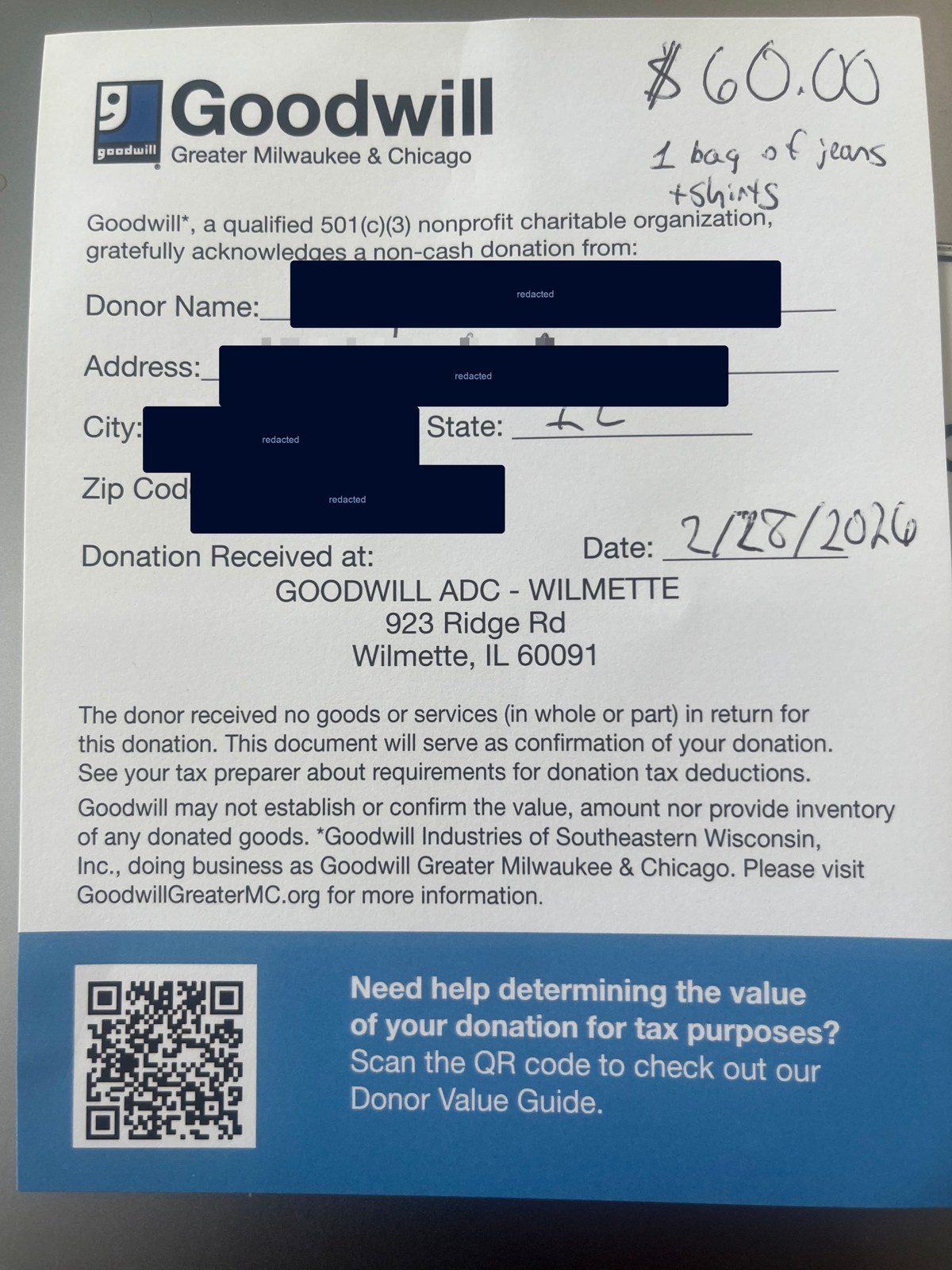 My own Goodwill receipt from February. I wrote in the "$60.00, 1 bag of jeans + shirts" at the top. (I blacked out my name and address.)
What a Goodwill donation receipt is, and what it isn't
The receipt is Goodwill's thank-you note. It says a registered charity received goods from you on a given day, and that you got nothing back in return. That's the part Goodwill handles.
What it is not is a valuation. Look at the bottom of my receipt and you'll see Goodwill says so in plain print: it "may not establish or confirm the value, amount nor provide inventory of any donated goods." They even point you to a Donor Value Guide for help. In other words, the dollar figure is yours to fill in, and yours to back up. That trips people up, because every store receipt you've ever gotten came with the price already on it. A donation receipt is the opposite. The charity proves you gave; you prove what it was worth.
What to write on a Goodwill donation receipt
The blank middle of the slip is the part you fill in, and it's the whole job. Three things go there:
- What you gave, listed item by item instead of "a bag of stuff."
- The condition each item was in, whether good or only fair.
- A fair price for each one, which you add up at the bottom.
Here's the same receipt with every part labeled.
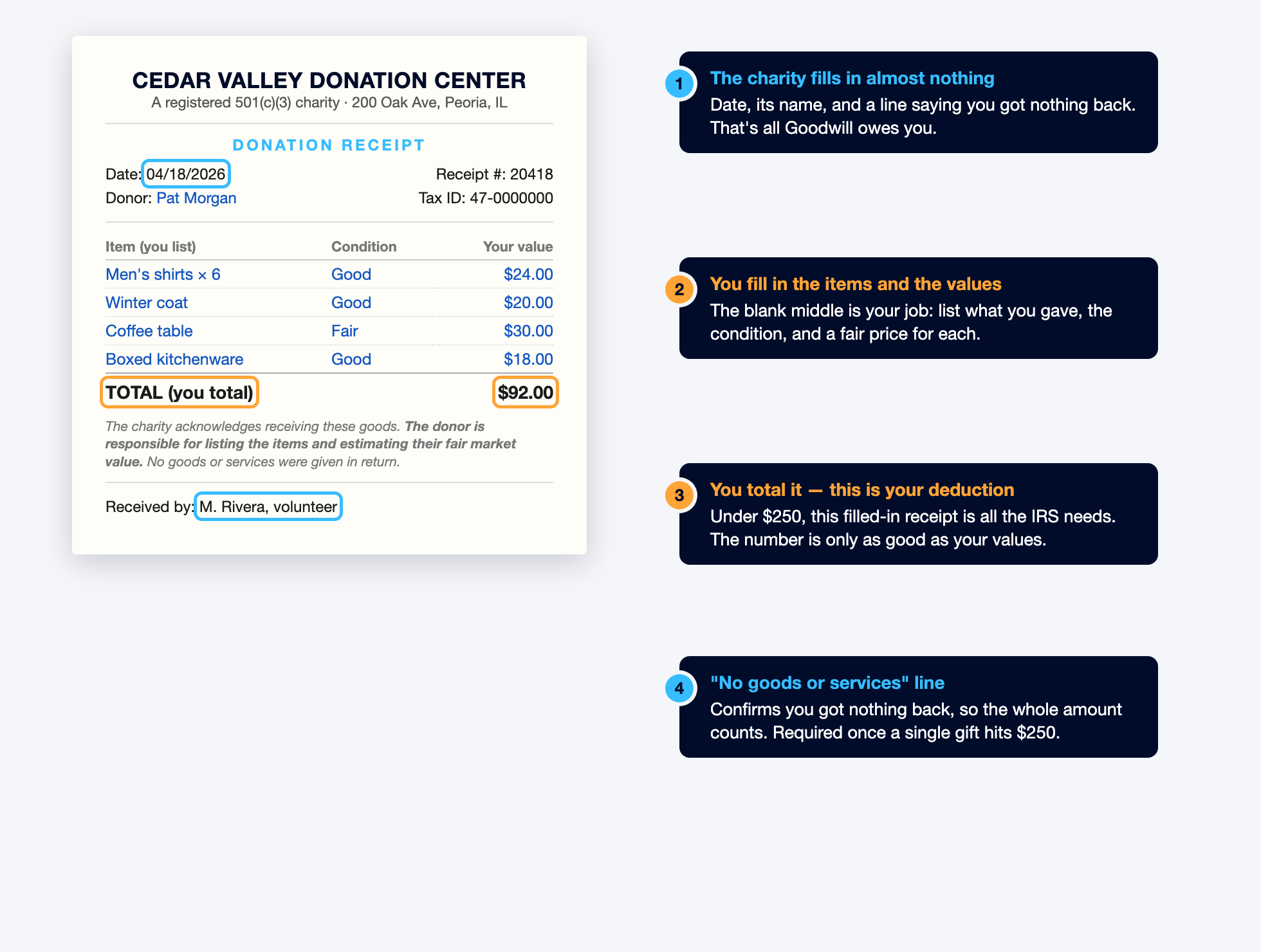 The charity fills in the blue parts. The orange parts, the items and the values, are on you. (Cedar Valley Donation Center is made up for the example.)
Write it like a list someone else could check: "Men's shirts, 6, good, $24." "Winter coat, good, $20." The more specific you are, the easier it is to stand behind later. Goodwill describes the gift on its end, but the IRS rule for the written acknowledgment is the same: it shows "a description (but not the fair market value) of any contribution of property." The value is always the donor's call. So make the call, and write it down while you still remember what was in the bag.
How to value your donated goods
This is the part everyone guesses at, and guessing high is how deductions get thrown out. The IRS standard is fair market value, which Publication 561 defines simply:
"The price that property would sell for on the open market. It is the price that would be agreed on between a willing buyer and a willing seller, with neither being required to act, and both having reasonable knowledge of the relevant facts."
IRS, Publication 561
In plain terms: what would this sell for at a thrift store, not what you paid for it new. The same publication says it straight: "Used clothing and other personal items are usually worth far less than the price you paid for them." A coat that cost you $120 might be worth $20 used. Walk the racks at a Goodwill store and you'll see the going rate. Set each item at what it would sell for in the condition yours is in, and that's your number. Goodwill's own Donor Value Guide (the QR code on the receipt) gives ranges for common items, and it's a fine place to start.
Does your Goodwill receipt count for the IRS?
One thing to settle first: a charitable donation only lowers your taxes if you itemize your deductions instead of taking the standard deduction. Most people take the standard deduction and get nothing extra for donating, so if you're not sure which you do, ask your tax preparer before you count on the write-off. If you do itemize, here's how the receipt works. For most drop-offs, the filled-in receipt is all you need, and the size of the gift sets the rest of the rules.
| Your donation | What you need |
|---|---|
| A single drop-off under $250 | The filled-in Goodwill receipt, kept with your records |
| A single drop-off of $250 or more | A written acknowledgment from Goodwill, in hand before you file |
| More than $500 in noncash gifts for the year | The receipts, plus IRS Form 8283 filed with your return |
The $250 line is the one to watch, and Publication 1771 draws it clearly:
"Donors are responsible for obtaining a contemporaneous written acknowledgment from a charitable organization for any single monetary contribution or noncash contribution valued at $250 or more before donors can claim a charitable deduction on their federal income tax returns."
IRS, Publication 1771
Once your total noncash giving for the year tops $500, you add Form 8283 to your return. The IRS is plain about the trigger: you file it "when the amount of their deduction for all noncash gifts is more than $500." This is the donor side of the receipt. If you run the charity and need to hand these out, our donation receipt template for nonprofits covers that end, and our guide to tax receipts walks through the cash-gift rules.
The charity deduction most people miss: your miles
Here's the nice surprise I promised: the drive counts too. The miles you put on the car hauling that donation to Goodwill are themselves a charitable gift, deductible at 14 cents a mile. Publication 526 sets the rate flat out: "you can use a standard mileage rate of 14 cents a mile to figure your contribution." So is driving for your church, delivering for a food bank, or any other trip you make for a charity. It all counts.
One trip won't make you rich. The six miles to my Goodwill and back came to 84 cents. But add up a year of donation runs, volunteer shifts, and charity errands and it's real money, sitting in your car the whole time.
There's one rule, and it's the easy part: keep a record of the miles. Publication 526 is blunt about it: "You must keep reliable written records of your car expenses." No log, no deduction. A mileage log with dates is all the IRS wants, and a tax preparer can confirm which of your trips qualify.
Nobody hands you a receipt for a drive, though, so the miles are the easiest deduction to lose. We built the Shoeboxed app to catch them for you. Turn on tracking and we log every drive by GPS. That evening you get one text with your trips, and you just reply which were for charity.
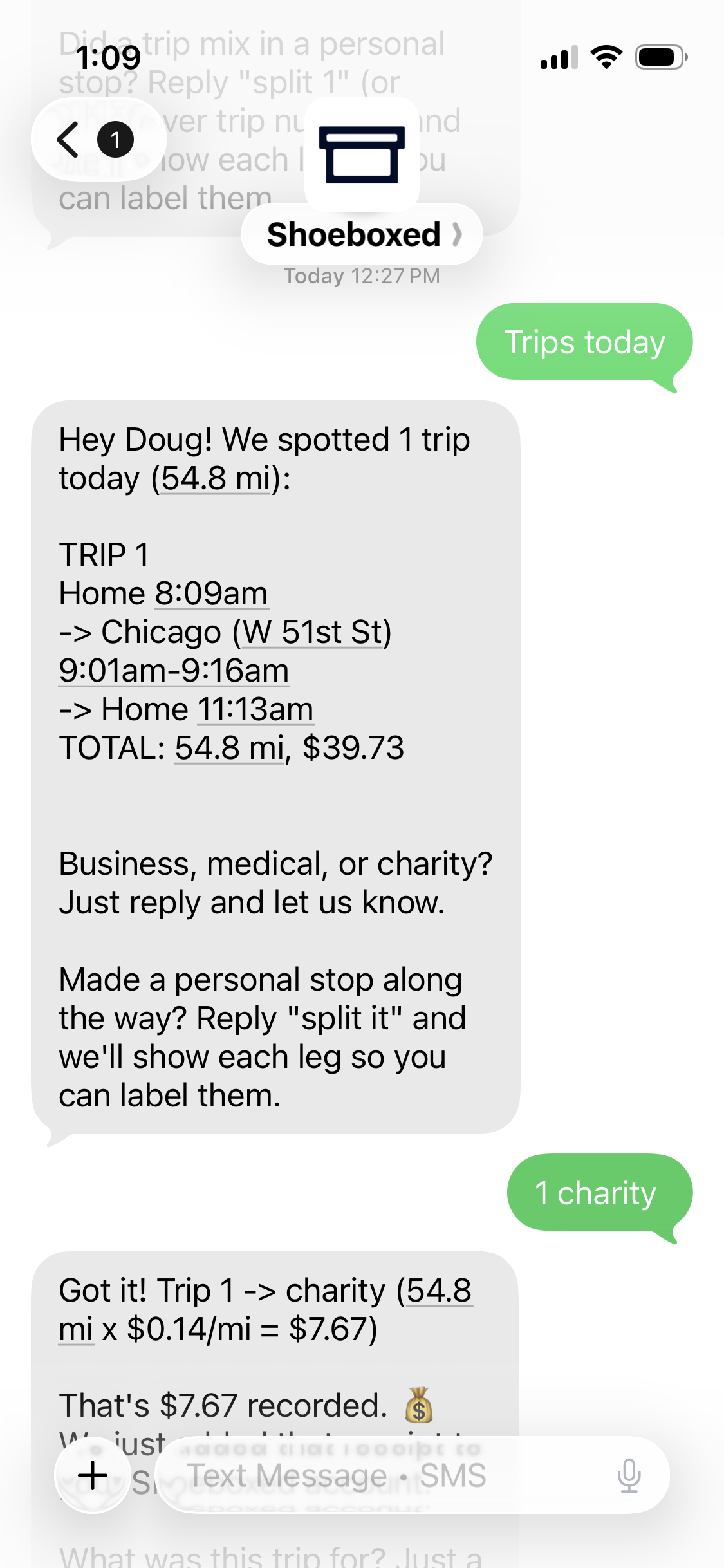 One text at the end of the day. I replied "1 charity," and Shoeboxed ran the math at 14 cents a mile and filed it. (This one's my real drive to go volunteer at a soup kitchen.)
That one-word reply is the whole job. We turn the trip into a finished mileage receipt, with a route map, the IRS category, and the dollar amount, saved in your account right next to your donation slips.
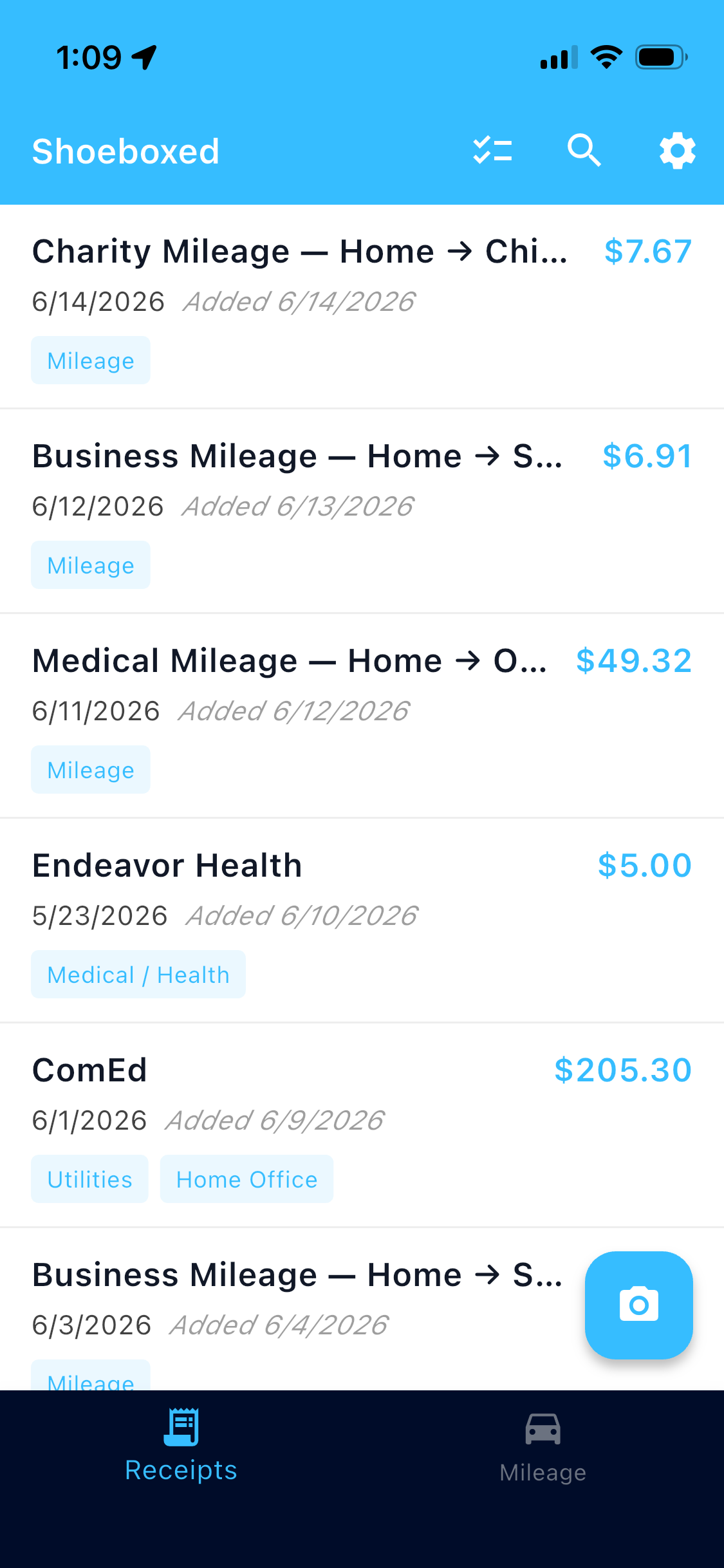 The charity mileage receipt Shoeboxed builds for you, route map included. It's exactly the "reliable written record" Publication 526 asks for, and you didn't write a word of it.
The receipt builds itself while you drive. That's the part most people never knew they were leaving behind.
How long to keep it, and how to not lose it
Keep the receipt at least three years, since that's how far back the IRS usually looks at a return. Six years if you ever leave out more than 25% of your gross income. For most people, three years is the honest answer, and keeping it longer never hurts.
The catch is the slip itself. A donation receipt is a thin piece of paper that lives in a cupholder, and cupholders eat paper. Snap a photo the day you get it and the three-year question takes care of itself. That's the whole reason Shoeboxed exists: send us the slip and we keep the image, pull out the date and the amount, and file it where you can find it. You can get receipts to us five ways:
- Snap a picture in the app before the slip leaves the car.
- Drop the paper in a prepaid Magic Envelope and mail it to us.
- Forward an emailed receipt to your Shoeboxed address.
- Let our Gmail plugin pick up emailed receipts on its own.
- Upload or drag and drop on the website.
Never lose a receipt again. Join the people who scan receipts, track charity miles, and build IRS-ready records with Shoeboxed. See how it works.
For the bigger picture on which slips are worth keeping, here's our guide to the types of receipts and what the IRS expects in our IRS receipt requirements guide.
Frequently asked questions about Goodwill donation receipts
Is it worth getting a donation receipt from Goodwill?
Yes, if you itemize. The receipt is your proof that the donation happened, and for a gift of $250 or more you can't claim the deduction without one. Even for smaller gifts, it's the record that backs up your number if anyone asks.
Does Goodwill give you a donation receipt?
Yes. Drop off goods at any Goodwill and they'll hand you a receipt or offer a digital one. It acknowledges the donation but leaves the items and the value blank for you to fill in.
What do I write on a Goodwill donation receipt?
List the items you gave, the condition of each, and a fair market value for each, then total it. Goodwill won't value your goods for you, so that part is the donor's job.
How do I figure out the value of my donated items?
Use fair market value, which is what the item would sell for used, not what you paid new. Thrift-store prices are the best guide, and Goodwill's own Donor Value Guide lists ranges for common items.
Can I deduct mileage for charity?
Yes. You can deduct 14 cents a mile for driving you do for charity, including the trip to drop off a donation, your volunteer shifts, and other charity errands. The one requirement is a written record of the miles, so keep a log with dates. A tax preparer can confirm which of your trips qualify.
How long should I keep my Goodwill receipts?
At least three years, since that's the usual IRS window for reviewing a return. Keeping a digital copy longer is easy and never hurts.
Final thoughts
A Goodwill donation receipt is half-finished when they hand it to you. The charity proves you gave; you prove what it was worth. Fill in the items honestly, value them at what they'd sell for used, and save the slip before it fades. Do that, and the bag of clothes you almost forgot about turns into a deduction you earned.
About the author. I'm Doug. I bought Shoeboxed in late 2025 with an SBA loan after fifteen years of running other people's companies as CEO. I'd used Shoeboxed myself back in 2010 at a previous gig and called it magical even then. I use it daily now, and yes, that's my real Goodwill receipt up top. Small business owners deserve every dollar they're legally entitled to keep, which is why I bought Shoeboxed and work hard to make it better.
Sources
- IRS, Publication 1771, on the $250 written-acknowledgment rule and what the acknowledgment must contain.
- IRS, Publication 561, on fair market value and valuing used clothing and household goods.
- IRS, About Form 8283, on the more-than-$500 noncash filing requirement.
- IRS, Publication 526, on the 14-cents-a-mile charity rate and keeping written records.
30 Seconds Could Save You Thousands on Taxes
Self-employed? Get an instant, personalized tax-savings estimate.




 4.4 / 5 on