Can I Use My Gas Receipts for Taxes? The Honest Answer
Can you use gas receipts for taxes? It depends on which method you pick. See when gas receipts count, when they don't, and how to keep the records that hold up.


Updated June 2026.
Your gas receipts only count for taxes if you use the actual-expense method to deduct your car. If you use the standard mileage rate instead, the IRS pays you per mile, and your gas receipts do nothing. Which method you choose decides it, and you need a mileage log either way.
Imagine you're a house cleaner driving between three jobs a day, saving every gas receipt in your glovebox because someone told you they're worth money at tax time. Or maybe you're a real estate agent with a year of pump receipts crammed in a drawer. Did you know that for most drivers, those receipts are worth nothing on your taxes? Keep reading and I'll show you when gas receipts count, when they don't, and what to keep instead.
I'm Doug. I own Shoeboxed, and we've helped small businesses sort out receipts since 2007. Gas is one of the things people save the most and understand the least, and our own data shows it.
"Nearly 4 in 10 active Shoeboxed accounts (5,056 of 12,695) save auto, fuel, or vehicle receipts. That's more than 300,000 fuel and car receipts since January 2024, and most of those drivers would be better off counting miles than saving the receipts."
Shoeboxed customer data, June 2026
First, are you an employee or self-employed?
This is the decision that decides everything, so start here.
If you're self-employed (a sole proprietor, a single-member LLC, or a 1099 contractor who files a Schedule C), you can deduct the cost of driving for your business. Gas is part of that. Read on, because the rest of this article is for you.
If you're a W-2 employee , the news is harder. Since the 2018 tax law, most employees can't deduct unreimbursed car costs on a federal return at all, and saving your gas receipts won't change that. Only four narrow groups still get to deduct:
- Armed Forces reservists
- Qualified performing artists
- Fee-basis state or local government officials
- Workers with disability-related job costs
Everyone else who drives for a W-2 job has one fix, which is to ask the employer to reimburse business miles instead of hoarding receipts.
And one rule catches everyone: the drive from home to your regular workplace is a personal commute, never a deduction, no matter who you work for.
When your gas receipts count, and when they don't
If you're self-employed, the IRS gives you two ways to write off your car. You pick one. Whether your gas receipts matter at all comes down to which one you choose.
The standard mileage rate (your gas receipts don't matter)
With the standard mileage method, you don't add up gas, oil, or repairs. You count your business miles and multiply by the IRS rate. For 2026 that rate is 72.5 cents a mile, up 2.5 cents from 2025. That single number already bakes in gas, maintenance, insurance, and wear on the car.
So if you go this route, your gas receipts do nothing for your taxes. What you need instead is a mileage log, where each trip shows four things:
- The date you drove
- Where you went
- The business reason for the trip
- The miles
This is where most people lose money. They save a shoebox of gas receipts and never write down a single trip, then find out at tax time that the standard method runs on miles, not fill-ups.
The actual-expense method (your gas receipts matter)
With the actual-expense method, you do the opposite. You add up everything the car costs for the year and deduct the business share. Now your gas receipts are real money, alongside the rest. The IRS lets you count:
- Gas and oil
- Repairs and tires
- Insurance
- Registration and license fees
- Lease payments (or depreciation if you own the car)
You can't deduct all of it unless you drive only for work. You figure your business-use percentage (business miles divided by total miles) and apply that to every cost. Drive 60% for business, deduct 60% of the gas. And yes, you still need a mileage log, because that percentage comes from your miles.
Which method saves you more?
Here's one driver, both methods. She's self-employed, drove 12,000 business miles out of 20,000 total (so 60% business use), and spent about $9,200 on the car for the year.
| The math | Standard mileage | Actual expenses |
|---|---|---|
| Business miles | 12,000 | 12,000 |
| How it's figured | 12,000 × $0.725 | $9,200 × 60% |
| Deduction | $8,700 | $5,520 |
Say $2,800 of that $9,200 was gas. On the actual method only the business share counts, so her careful gas receipts add up to about $1,680 of deductible fuel. The standard rate beats her whole actual-expense total by $3,180, so she's better off counting miles.
But it doesn't always go that way. If you drive an expensive truck, put on low miles, or had a brutal year of repairs, the actual-expense method can win, and then your gas receipts earn their keep. Drive an ordinary car and pile on the miles, though, and the standard rate almost always wins, which means your gas receipts won't add a dime. The honest move is to run it both ways once and pick the bigger number.
One rule locks you in. If you want the standard rate for a car you own, you have to choose it the first year you use that car for business. Pick actual expenses that first year, and you're stuck with actual expenses for that car. A leased car is even stricter, where choosing the standard rate means you keep it for the whole lease.
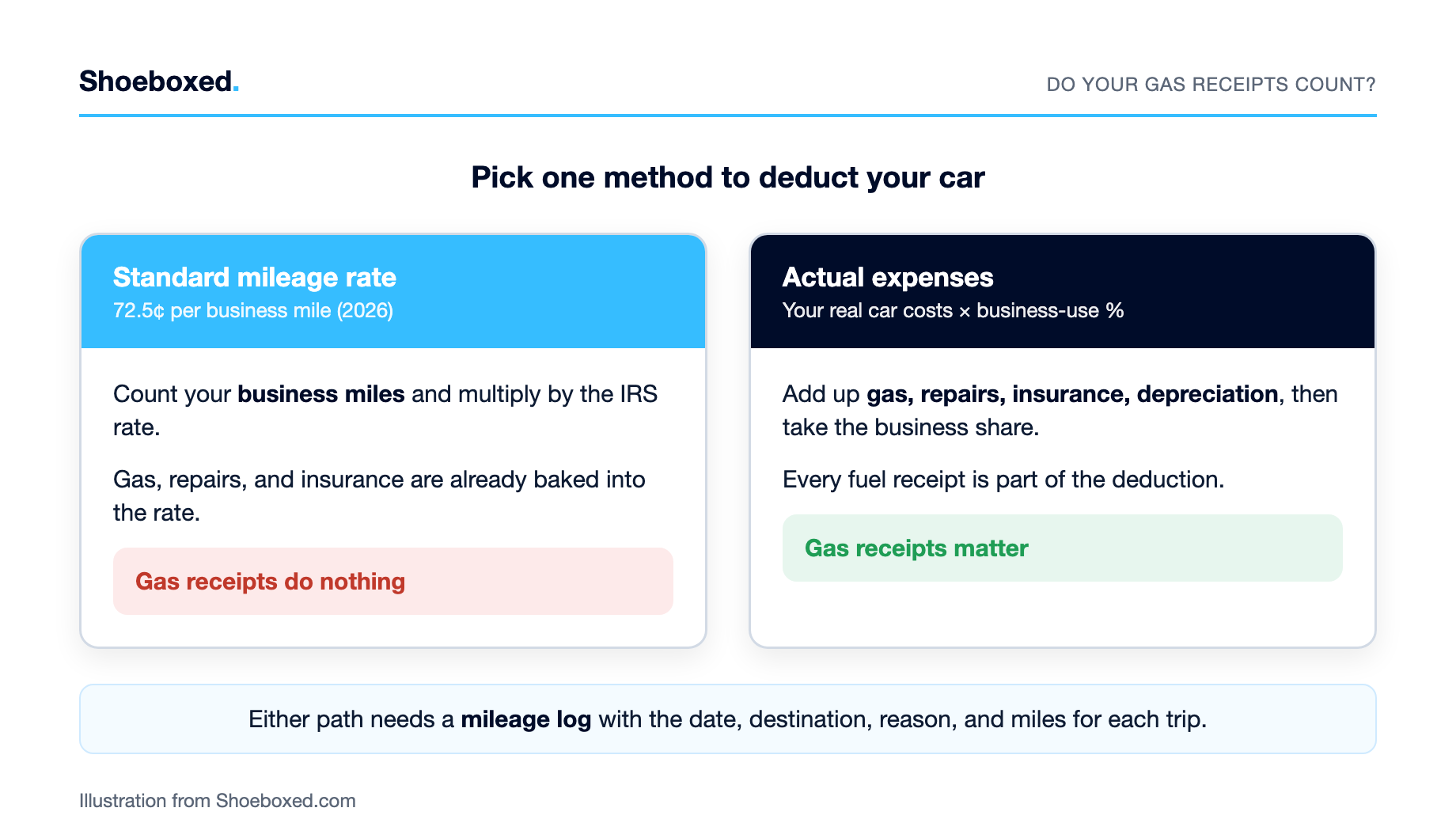 The fork that decides whether your gas receipts matter. Both paths need a mileage log; only one path needs the receipts.
When you have no choice but to keep gas receipts
Some drivers don't get to pick. The IRS bars the standard mileage rate in two cases. Both push you onto actual expenses, so you have to save every fuel receipt:
- Heavy trucks. A vehicle that weighs over 6,000 pounds loaded doesn't count as a car for the per-mile method, and you can check that weight on the sticker inside the driver's door. Most heavy trucks and big rigs are over the line, so their drivers deduct actual fuel, repairs, and depreciation instead of cents per mile.
- Fleets of five or more. If you run five or more vehicles in your business at the same time, you can't use the standard rate on any of them. You're on actual expenses across the board.
If either describes you, your gas receipts aren't optional paperwork. They're the deduction itself, and a missing one is money gone.
If you drive a big rig across state lines, you need those fuel receipts for a second tax too. Every quarter you report how many gallons you bought in each state on a state fuel-tax return (truckers call it IFTA), so the gallons and the location on the receipt matter as much as the dollar total. Our truck driver expenses worksheet covers the rest of a trucker's write-offs.
The Fuel Tax Credit is a separate thing (don't get tricked)
Search for gas and taxes and you'll land on an IRS page about the Fuel Tax Credit. It sounds perfect, but it usually isn't the thing you want.
The Fuel Tax Credit refunds the federal tax on fuel that never touches a public road. The IRS spells out who it's for: farming, off-highway equipment on private land or a construction site, and commercial fishing boats. If you drive a normal car or truck on regular roads for your business, this credit isn't yours, and claiming it wrong is a known audit flag. Your driving belongs on the mileage or actual-expense path above, not here.
How to keep gas receipts the easy way
Say you're on the actual-expense method, or you drive a heavy truck or a fleet and have no choice. Now your gas receipts are real money, and a lost one costs you. This is the exact mess we built Shoeboxed to handle.
Snap a photo of the receipt at the pump, forward an emailed receipt from the gas station app, or drop a month of paper receipts in a prepaid Magic Envelope and mail them to us. We store the actual receipt image, and our software pulls out the vendor, the date, and the total, the three things the IRS wants to see. Everything stays in your account for as long as you're a customer, and you can export all of it if you ever leave.
A gas receipt that fades to blank in your console six months from now is a deduction you can't prove. A photo taken the day you bought the gas holds up.
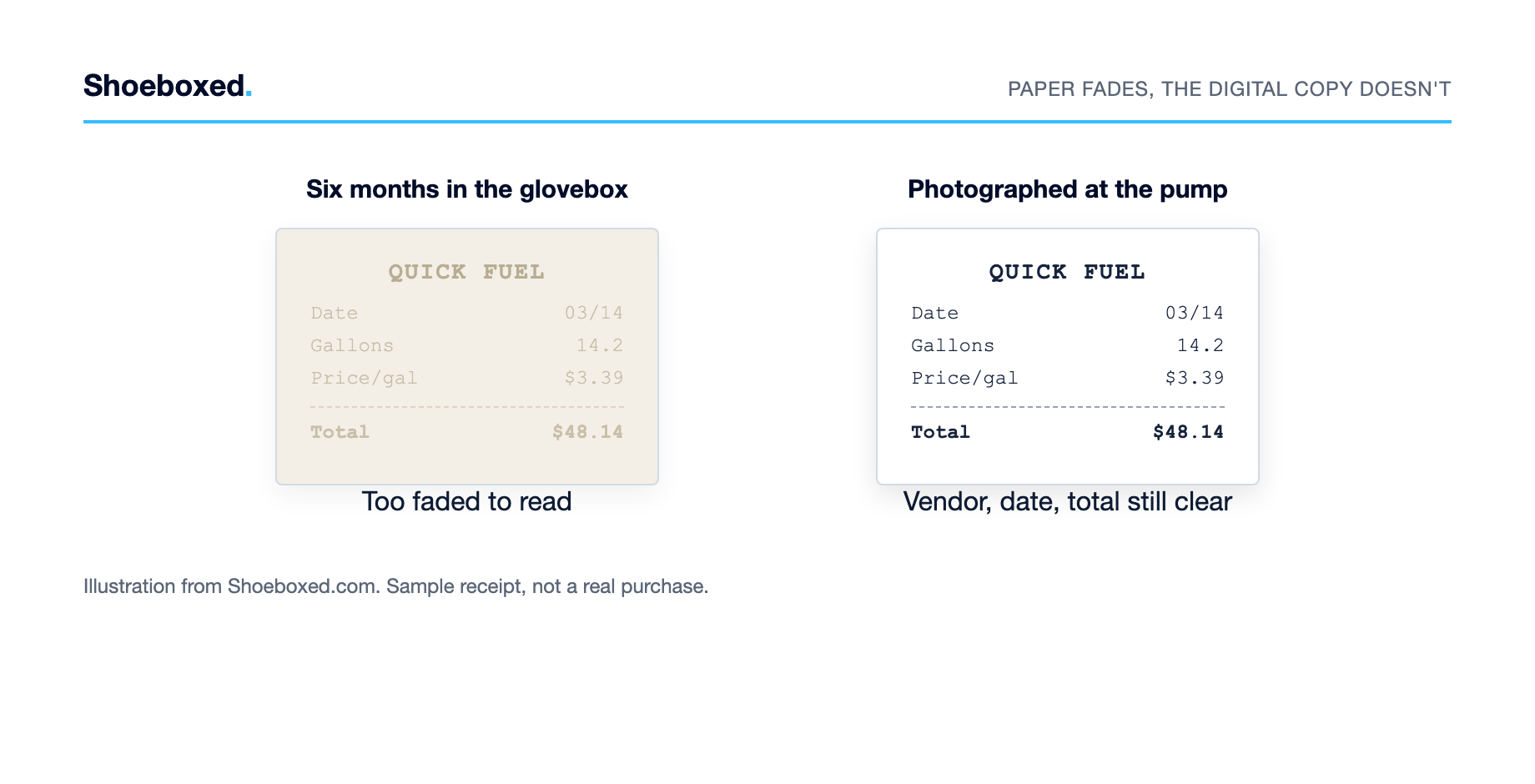 Thermal gas receipts fade. A digital copy keeps the vendor, date, and total readable years later. (Sample for illustration.)
Gas receipt tax FAQ
What is the $75 rule for receipts?
The IRS doesn't require a paper receipt for most travel and transportation costs under $75 (lodging is the exception). You still have to write down the amount, date, place, and business reason for the expense. So the $75 break frees you from saving the slip of paper, not from keeping a record. We'd hang onto the receipts anyway, because the $75 line is a floor, not permission to throw things out, and a clean record still wins an audit.
How much gas can I claim on my taxes?
There's no flat dollar limit. On the actual-expense method, you claim the business-use share of what you spent, so 60% business use means 60% of your gas. On the standard mileage method, you don't claim gas at all; you claim 72.5 cents per business mile for 2026.
Can I still claim the expense if I lose a gas receipt?
Maybe. A bank or credit card statement showing the purchase, plus a mileage log of where you drove and why, can back up the deduction if the original is gone. It's weaker than the receipt itself, which is why the easy fix is to capture each one the day you get it.
How long should I keep gas receipts?
Keep them at least three years from the day you file, since that's the usual window the IRS can look back and ask. If you under-reported your income by a lot, that window stretches to six years, so plenty of people just keep everything longer to be safe.
Do I need a mileage log even if I save gas receipts?
Yes, you need one for both methods. The standard rate runs on the miles you log, and the actual-expense method uses those same miles to figure your business-use percentage. There's no version of this where the log is optional.
About the author. I'm Doug. I bought Shoeboxed in late 2025 with an SBA loan after fifteen years of running other people's companies as CEO. I used Shoeboxed myself back in 2010 at a previous job and called it magical even then. I run a small business too, so I know how fast a glovebox full of gas receipts turns into a tax-time headache.
Stop losing gas receipts. Shoeboxed scans and organizes your fuel and vehicle receipts and tracks your business miles with GPS, so your records are ready whichever method saves you more. See how it works.
Sources
- IRS: 2026 standard mileage rate announcement
- IRS Topic No. 510: Business Use of Car
- IRS Publication 463: Travel, Gift, and Car Expenses
- IRS Publication 529: Miscellaneous Deductions
- IRS Publication 583: Starting a Business and Keeping Records
- IRS: Fuel Tax Credit
- Shoeboxed customer data: 5,056 of 12,695 active accounts log vehicle receipts (June 2026)
30 Seconds Could Save You Thousands on Taxes
Self-employed? Get an instant, personalized tax-savings estimate.




 4.4 / 5 on