Using a Virtual Address for Your LLC: The Complete 2026 Guide With Pricing
A complete 2026 guide to virtual addresses for LLCs, written by the former CEO of Earth Class Mail. Pricing, provider comparison, state rules, and how to get your home address off the public filing.

Using A Virtual Address For Your LLC: The Complete 2026 Guide With Pricing
By Doug. Former CEO of Earth Class Mail (2015-2017). Now owner of Shoeboxed. Last updated: May 2026.
The short answer: Use a virtual address. Cost runs $8-$50 a month, higher for the real ones. Avoid any provider whose address resolves to a USPS post office (the post office prohibits using their addresses for legal business filings). Avoid providers who just outsource everything to mailbox stores.
When you form an LLC, the address you use lands on a public Secretary of State filing. From there it gets crawled by search engines, picked up by data brokers, and surfaced on listings like Yelp and Google Business Profile. If you used your home address, your family's address is now part of the public record attached to your business name, and it is not coming off.
A virtual address solves that problem. You get a real US street address you can use on your LLC filing, your bank account, your vendor records, and your business cards, without putting your home address into public circulation.
This guide covers what a virtual address is, how the better providers work, what they cost in 2026, the state rules that matter, and how to fix the problem if your home is already on the filing.
I've seen the virtual address business from both sides, first as CEO, then as a customer. Xenon Ventures recruited me in July 2015 to run Earth Class Mail, one of the original virtual mailbox companies, after the company emerged from Chapter 11. I left in November 2017 and stayed on as a paying customer ever since. I also run Shoeboxed today, where we have scanned over 57 million receipts for more than 552,000 small businesses since 2007. The category and the customer profile are what I work in every day.
What is a virtual business address?
A virtual business address is a real street address at a commercial location, operated by a third-party mail-handling business, that you use as your business address on legal and financial documents.
Mail and packages addressed to your business go to that location instead of your house. Staff there receive the mail on your behalf. Some providers have staff scan the envelope on-site at the address and upload it to a digital dashboard. Others ship the mail to a central scanning facility first. Once scanned, you can access your mail from anywhere.
From the digital dashboard, you decide what happens to each piece: open and scan the contents, forward the physical piece to your house, hand off to your accountant, shred, or deposit if it's a check. The mail stops landing on your kitchen counter.
The address itself is what most LLC owners care about. It is a real street, in a real city, in a real building, with a real suite or PMB (Private Mailbox) number, accepted by banks, state agencies, and vendors. Customers who Google your business see a commercial location, not your living room.
Virtual address vs virtual mailbox: not the same thing
A virtual address is the street address itself, the thing that shows up on your LLC filing and your bank statement. A virtual mailbox is the mail-handling service that sits behind that address, where someone scans your mail and uploads it to a digital inbox you can act on from a screen.
Not every virtual address comes with a virtual mailbox. A UPS Store mailbox, for example, gets you a real street address but no scanning service. Mail sits in the box until you physically walk in and collect it. No digital inbox, no remote forwarding from a click, no check deposit, just a locked box you have to drive to.
When you are shopping, make sure the address you sign up for includes the mailbox service, not the street number alone. Here is a deeper breakdown of what a virtual mailbox does.
How a virtual address for business works
The flow is the same at every reputable provider:
- You pick a city, then a specific address inside that city, from the provider's available inventory.
- You sign up and pay the monthly subscription.
- You complete USPS Form 1583, which is the federal form authorizing the provider to receive mail on your behalf. The form requires two forms of ID and a notarized signature.
- The provider activates your address.
- You update your LLC filing, your bank, your vendors, and your customer records to use the new address.
From that point forward, every piece of mail addressed to your business goes to the provider's location. How the mail gets digitized from there depends on the provider's ops model. Some scan the envelope on-site at the address. Others ship envelopes to a central scanning facility, sometimes batched by day or by week. Either way, you get a notification when the scan posts, open the dashboard, and tell the provider what to do with each piece: scan the contents, forward to your house, shred, or pick up locally.
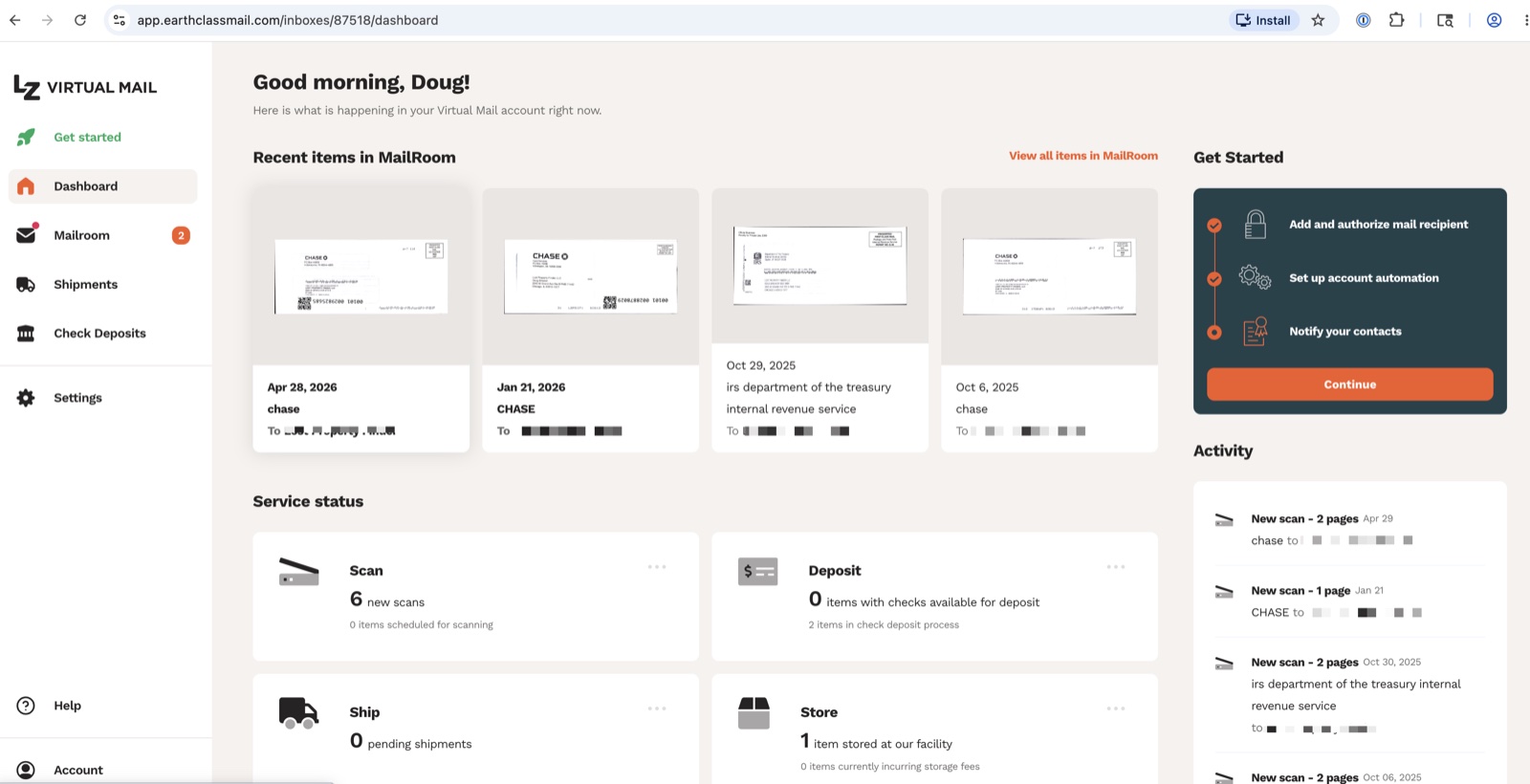 Inside my Earth Class Mail dashboard. Mail opened, scanned, dropped into a digital inbox I can act on from anywhere.
Having run a virtual mail operation, I can tell you what happens behind the scenes is not glamorous. There is a warehouse, scanners, and the people running them. Quality depends on who runs that warehouse. Either the provider runs it themselves, or a network of local pack-and-ship stores does. Both models exist and they produce sharply distinct customer experiences. The on-site-scan vs ship-to-central-facility choice is part of the same picture, and it drives turnaround time. More on that below in the provider comparison.
Virtual address vs physical office space
Three options most LLC owners weigh: keep using the home address, rent a physical office, or use a virtual address. The math is rarely close.
Home address. Free, but your home address is now on a public filing forever and shows up when people Google your business. Privacy gone, professionalism dented, and if you ever move you have to update the address everywhere it has been filed. Your personal mail gets mixed with your business mail, which makes it easy to miss critical mail from the IRS, state employment agencies, insurance companies, and other important organizations.
Physical office. Real lease, $500+ a month depending on the city, plus utilities, internet, and the time cost of running it. Makes sense for a business that needs the physical space. Wildly overkill for a solo LLC owner working from a laptop.
Virtual address. $8-$50 a month for a real commercial address you can use the same way you would use a leased office address, without renting the space. For an LLC owner who works from home, this is the answer most of the time.
Virtual office. $50+/mo, think of this like a Regus, business center, WeWork, etc. Some of these providers will include or sell a virtual address, and include a certain number of days in the business center. It's a good option if you want to have client meetings in a professional setting regularly, but don't want to lease a full office.
Virtual address for LLC: what you need to know
A virtual address is legitimate for LLC registration in most US states, but the implementation has to be done right. A few things to watch for.
Make sure the address is a real CMRA, not a USPS post office
A CMRA (Commercial Mail Receiving Agency) is a private mail-handling business that is registered with USPS and licensed to receive mail on behalf of customers. CMRAs operate at real commercial street addresses, with real suite or PMB numbers, and the addresses are accepted by banks, state agencies, and registered agents.
A USPS post office is a separate facility entirely. Some virtual mailbox providers offer addresses that resolve back to a USPS post office, where the "suite number" is a PO Box number underneath. The USPS Customer Agreement for Premium PO Box Service is explicit on this: "You may not use the PO Box 'street address' option as your physical residence or place of business in legal documents."
That's not a typo. USPS forbids using their PO Box street-addressing as a legal business address. Banks and state SoS offices know this, and they reject addresses that resolve back to USPS post offices when they catch them. Yet some virtual mailbox providers sell those addresses for LLC registration anyway. Snap Mailbox is one I have email evidence on.
Here is what that looks like. On their public addresses page, Snap Mailbox lists "522 N Central Ave #831, Phoenix, AZ 85004" as one of their virtual addresses for sale.
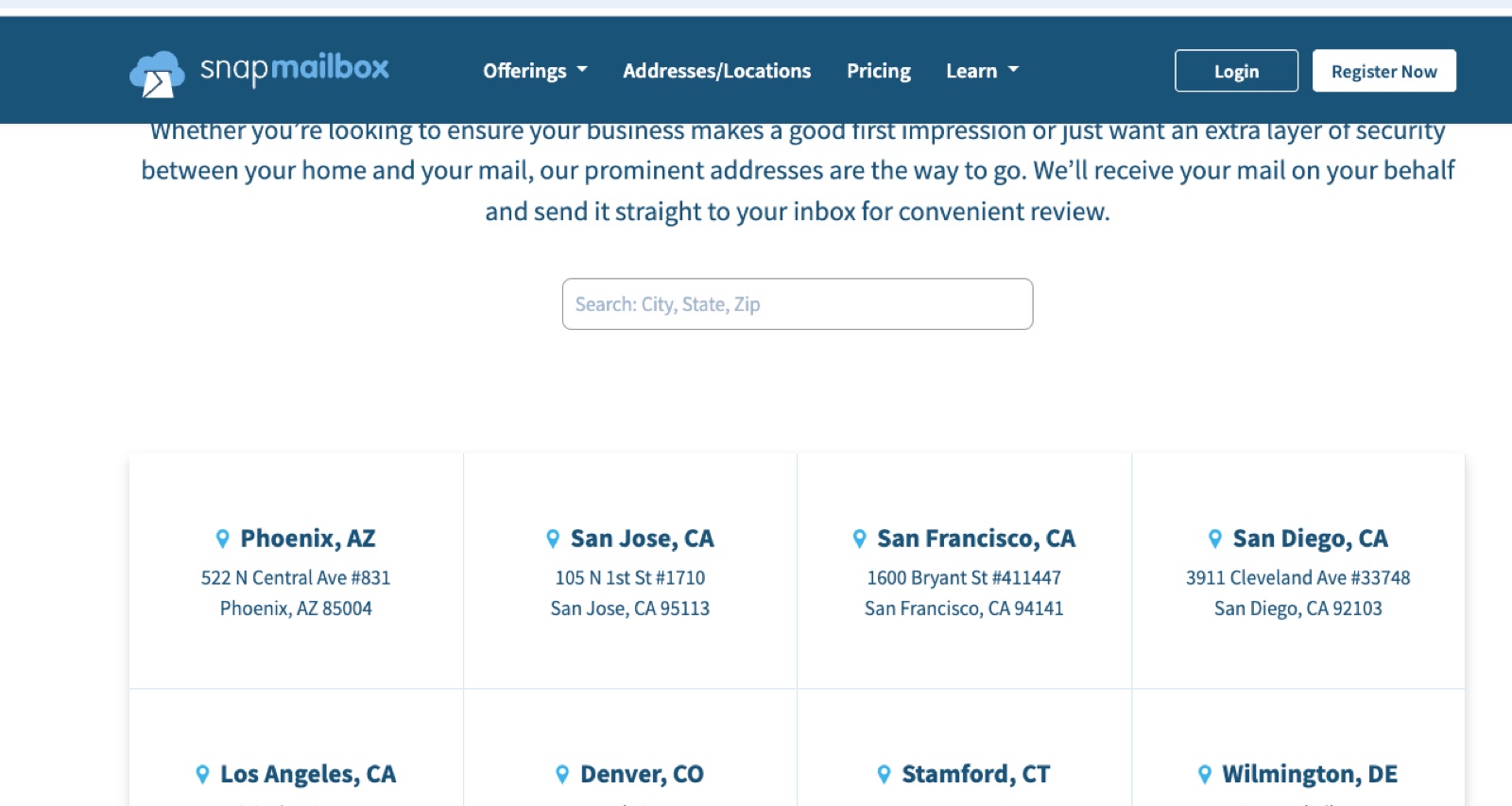 Screenshot from snapmailbox.com.
Drop that address into Google Maps and the building that comes back is the United States Postal Service Downtown Phoenix branch. The carved-stone "UNITED STATES POST OFFICE" sign is right there above the front door on Street View.
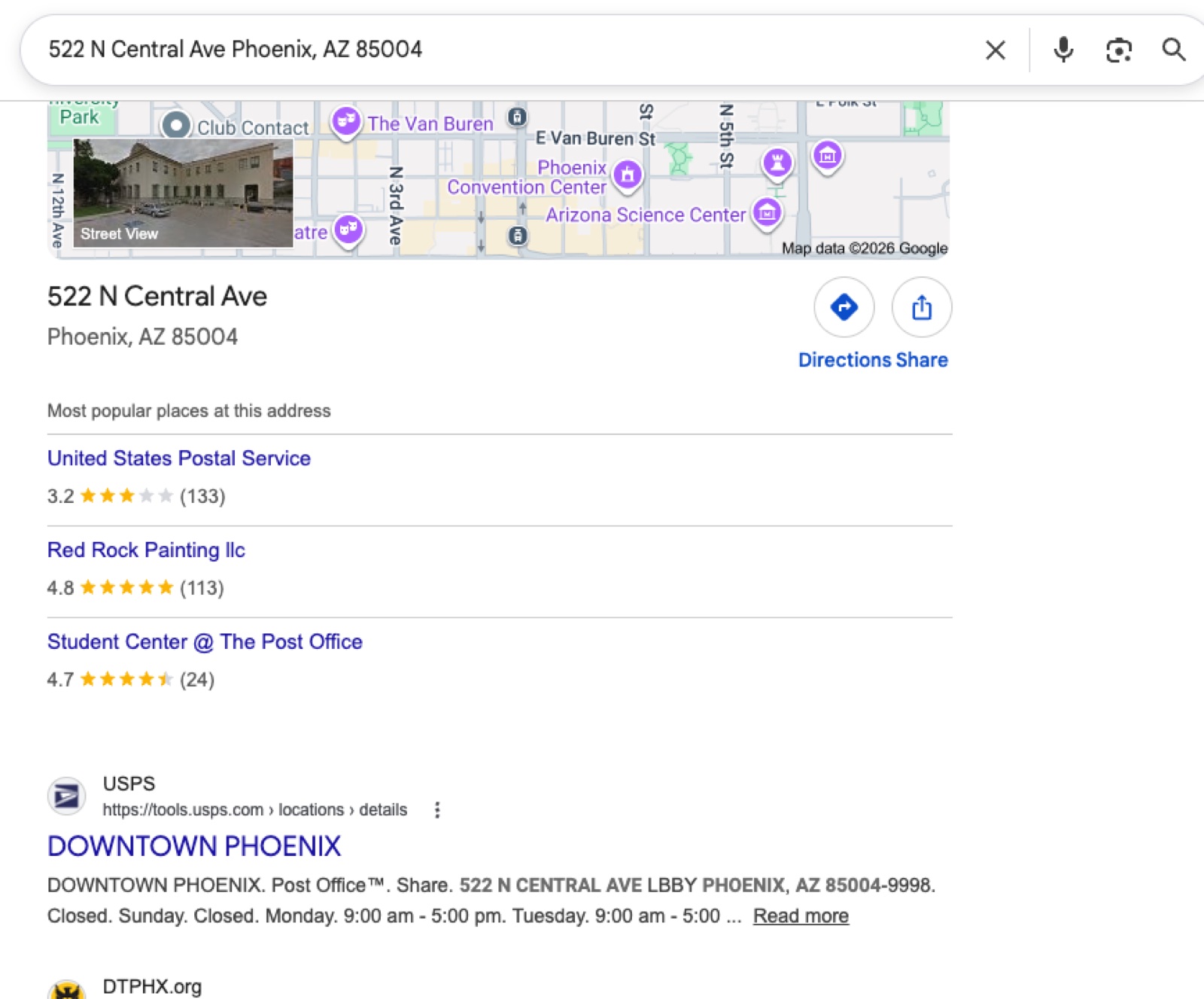 Map data (C) Google. Screenshot from Google Maps.
That is a USPS post office street address being resold as a business address for LLC filings, in direct violation of the USPS Customer Agreement quoted above.
If you are shopping, the test is simple. Punch the candidate address into Google Maps. If it returns a commercial building or storefront, you are good. If it returns the local USPS post office, walk away. I will name names in the provider comparison further down.
Two state rules that change the virtual-address calculus
Most states accept a virtual CMRA address for the LLC's principal business address. Two states have rules that directly affect which virtual address you can pick:
- Texas. A registered office "cannot...be a post office box that is part of a commercial mail or message service unless that commercial enterprise is the registered agent" (Texas SoS, Registered Agent FAQ). Translation: a virtual mailbox address only works as the Texas registered office if the same provider is also serving as your registered agent.
- New York. Within 120 days of formation, an LLC has to publish a notice in two newspapers in the county of its office for six consecutive weeks, then file proof with the Department of State (NY LLC Law §206). The address you publish has to match the address on your articles of organization, so pick the virtual address before publication, not after.
For any state, check the Secretary of State's filing requirements before you commit to a specific provider's address. The SBA's business registration guide is a useful starting point. Every state SoS runs a public business search, so you can also look up examples of LLCs that successfully filed with a virtual address in your state.
A virtual address is not a registered agent
A virtual address is where your mail goes. A registered agent is a designated person or service that legally accepts service of process for your LLC. Most states require an LLC to have a registered agent at a physical address in the state of formation.
Some virtual address providers also offer registered agent service. Many do not. If you are forming a new LLC, plan for both. Either pick one provider that bundles them, or pair a virtual address provider with a separate registered agent service.
Is a virtual address legal for business use?
Yes, in most cases, as long as the address is a real CMRA and you complete USPS Form 1583 to authorize the provider to receive mail for you.
The legitimacy depends on three things: 1. The address resolves to a real commercial building, not a USPS post office. 2. The provider is a USPS-registered CMRA. 3. You have completed Form 1583 with two forms of ID and notarized signature on file.
If those three are in place, banks accept the address for business banking, state SoS offices accept it for LLC filings, registered agent services accept it as the principal address, and the IRS accepts it for your EIN and your tax filings.
Benefits of a virtual business address
Five real benefits, in order of how much weight LLC owners put on them in practice.
1. Your home address stays off the public filing
Your LLC's registered address is a public record, and the state Secretary of State publishes it the day you file. From there, Google indexes it within days, data brokers scrape it within weeks, and Yelp pulls it onto your business listing if you set one up. Google Business Profile pulls it onto a Maps result.
Yelp's privacy policy openly acknowledges that the business address they display "is often also the owner's home address." Yelp will not remove a business page once it has been created. Once your home address is up there, it stays up there.
Google Business Profile gives you an option to hide a home address by marking the business as service-area-only. Sterling Sky's published test data shows that hiding the address drops your local search ranking. The tradeoff most home-based business owners do not see coming is real: expose your home address, or lose visibility.
A virtual address keeps your home off every one of these surfaces from the start.
2. Mail security and "do not lose this letter" reliability
Critical business mail looks like junk mail. The IRS envelope is white with a window in the front. State employment offices use the same boring window envelopes. Bank verification letters, business license renewals, and court notices show up looking like the credit card offers stacked next to them.
When that mail goes to a virtual address instead of your house, the operator opens it, scans it, tags it, and drops it into a digital inbox, so you catch it instead of letting it disappear under a stack of takeout menus.
I knew a founder who ran a small company out of an office. A letter from his health insurance carrier landed in the mail pile one Tuesday, got buried under junk, and sat there until coverage lapsed. A virtual address with same-day scanning makes that mistake structurally impossible.
3. Separation of business and personal
A clear paper trail at tax time. The IRS letter goes to your business inbox, your kid's school mailings go to your house, and your bank's business statements land at the business address while the personal ones stay home. The line between business and personal stays clean, which is what the IRS wants to see if your LLC ever gets audited.
4. Professionalism on customer-facing materials
A real business-center address in a commercial building reads as a real company, while a UPS Store mailbox reads as a side gig. Customers Googling your address notice, banks and state regulators notice, and any vendor doing a credit check on your business notices.
5. Mobility
Move next year and your business address does not move with you. The virtual address stays the same, which means your LLC filing, your bank, and your registered records all stay untouched while you change houses.
Limitations and risks to consider
Three legitimate limitations.
You still need to complete Form 1583 and notarize it. A friction-y first step that most providers now handle through remote notarization, so plan one evening for the setup.
You still need a separate registered agent in most states. Virtual address handles your mail; registered agent handles legal service of process. Separate role, separate service, mandatory in most states.
Bad providers exist. Cheap providers that use USPS post office addresses, or that hand mail handling to a network of pack-and-ship mailbox stores, produce inconsistent experiences. The comparison table below names which is which.
When a virtual address makes sense
Most LLC owners. Specifically:
- You work from home and your home address is currently on the filing (or about to be)
- You sell physical products or services and your business address shows up publicly
- You need a professional address for banking, licensing, or vendor onboarding
- You process at least occasional paper mail (IRS, state agencies, insurance, banking)
- You care about keeping a clean line between business and personal
If you also process paper checks, the math leans toward providers that bundle check deposit. My honest review of Earth Class Mail covers that side specifically, since their Checkstream feature is one of the few real check-deposit-by-mail products in the category. If you are newer to business banking, here is how to write a check so it clears the first time.
When a virtual address may not fit
A few cases where you can skip it.
- You already have a real commercial office address you use for the LLC
- Your business is registered in a state that does not accept virtual addresses (rare, but check)
- Your customers visit your business location physically (then you need a real location, not a virtual one)
- Your LLC has zero outside mail (pure online operation with no banking, no vendors, no public-facing presence, which almost no LLC actually fits)
Getting set up: provider comparison and pricing (2026)
Centralized providers run the mail facilities themselves. Partner-network providers sell you an address at a third-party pack-and-ship store, and the store owner does the scanning. Same price band, sharply different experience.
| Provider | Starting price | Operations model | Best for |
|---|---|---|---|
| PhysicalAddress.com | $7.98/mo | Centralized, owns all facilities | Cheapest legitimate option in the category. Real centralized operations across ~8 states. |
| Anytime Mailbox | $9.99/mo | Partner network (2,500+ third-party stores) | Cheapest broad-coverage option. Scanning quality varies by store. |
| iPostal1 | $9.99-$14.99/mo | Partner network (4,250+ third-party stores) | The most-searched-for provider in the category. Same partner-store caveat as Anytime. |
| PostScan Mail | $10/mo | Hybrid (small set of company-operated hubs; 1,000+ other addresses are partner stores) | Ask support which kind of location your nearest address is. Full review. |
| Earth Class Mail (LZ Virtual Mail) | $29-$79/mo | Mixed, real CMRA storefronts | Established, has check deposit. Now owned by LegalZoom. |
| Davinci Virtual | $49/mo | Office-first network | Higher price for office-network address quality. |
| US Global Mail | $49/mo | Centralized (Houston) | Single-facility, company-owned ops. International forwarding strength. |
| Stable | $59-$99/mo | Centralized, YC-backed | Modern API + AI features. Premium price. |
| Alliance Virtual Offices | $48-$79/mo | Contracted business centers (1,400+), central scanning | Virtual office, not just a mailbox: reception staff + meeting rooms included. Full review. |
Worth noting one category distinction: most providers in this table sell a virtual mailbox -- a street address with mail scanning. Alliance Virtual Offices sells a virtual office -- a virtual mailbox plus a real business center with reception staff and meeting rooms. Different product, different price tier, different buyer. See our Alliance Virtual Offices review for the full breakdown.
Centralized vs partner-network: the only filter that matters
The two largest networks in the category (iPostal1 and Anytime Mailbox) advertise thousands of locations. None of those locations are operated by the company themselves. Your address is a local pack-and-ship/mailbox store or coworking center, and the store owner does the scanning. The price is cheap because the model is decentralized. The quality of your experience depends on which store owner got your address.
Do you want the local pack-and-ship store owner snapping pictures of your IRS letters? Worth thinking about before you sign up. PhysicalAddress.com publishes its own page on why they do not use third-party locations. They are the cheapest centralized option for that reason. I have no commercial relationship with them, but at $7.98/mo for centralized ops, they are usually the cleanest recommendation for a new LLC owner with no existing address commitments.
If you process paper checks and want bundled check deposit, Earth Class Mail (now LZ Virtual Mail) is the answer despite the higher price. I covered the trade-offs in detail in the review.
Doug's pick by situation
- Brand-new LLC, no existing address, work from home: PhysicalAddress.com, $7.98/mo. Centralized ops, real CMRA, cheapest in the category. physicaladdress.com.
- You also deposit paper checks: Earth Class Mail (now LZ Virtual Mail) at $29/mo. The bundled check deposit is the reason. Full review here.
- Real business with clients, meetings, or a need for a professional lobby: Alliance Virtual Offices at $48-$79/mo. 1,400+ real business centers, reception staff on site, meeting rooms included, central secure scanning. The virtual office tier, not just a mailbox. Full review here.
How to change your LLC address if your home is already on the filing
If you formed your LLC and put your home address on the public record, you can still get it off. The process is a checklist, not a single step. Plan for an afternoon.
- Sign up for the virtual address. Pick the provider, complete Form 1583, get the address activated.
- IRS. File Form 8822-B (Change of Address or Responsible Party — Business). Walk-through in the next section.
- Your state Secretary of State. File an amendment to your articles of organization with the new address. The fee runs $25-$50 in most states. This is the public-record update that gets your home address off the SoS filing.
- Your bank. Call the business banking line and request an address change on every account, both deposit and credit.
- Your registered agent. Notify them of the new address so legal notices reach you.
- Every vendor that mails you invoices, statements, or 1099s. This is the longest part, so work through your vendor list one at a time.
- Google Business Profile and Yelp. Update the listing. The Yelp business page will keep the old address visible in archived results, but at least the current listing matches.
The new address starts showing up on public records and search results once each system reindexes. The old home address fades more slowly, since cached pages and archived listings stick around long after the underlying record changes. Plan on a long tail before the old address is gone from search results, and keep an eye on Google Business Profile and Yelp until the new listing is the one that surfaces.
How to file IRS Form 8822-B (the business change-of-address form)
Form 8822-B is the one-page IRS form that tells the federal government your business has moved. If your LLC has an EIN, you have to file it any time your business mailing address, business location, or responsible party changes. The IRS PDF is at irs.gov/pub/irs-pdf/f8822b.pdf.
What the form asks for:
- Boxes 1, 2, 3. Check every box that applies. Box 1 covers employment, excise, income, and other business returns (Forms 720, 940, 941, 990, 1041, 1065, 1120, etc.). Box 2 is for employee plan returns (Forms 5500, 5500-EZ). Box 3 is business location.
- Boxes 4a and 4b. Business name and Employer Identification Number.
- Boxes 5 and 6. Old mailing address and new mailing address. If your new address is a virtual CMRA, write the full street + suite/PMB number exactly as the provider issued it.
- Box 7. New business location, if different from the mailing address.
- Boxes 8 and 9. New responsible party's name and SSN/ITIN/EIN. The IRS defines "responsible party" as the person with effective control over the LLC. For a single-member LLC that is usually the owner.
- Box 10. Signature. Must be signed by an officer, owner, general partner, LLC member manager, plan administrator, fiduciary, or authorized representative.
Where to mail it (per the form's "Where To File" section):
- If your OLD business address was in Connecticut, Delaware, DC, Georgia, Illinois, Indiana, Kentucky, Maine, Maryland, Massachusetts, Michigan, New Hampshire, New Jersey, New York, North Carolina, Ohio, Pennsylvania, Rhode Island, South Carolina, Tennessee, Vermont, Virginia, West Virginia, or Wisconsin: send to Internal Revenue Service, Kansas City, MO 64999.
- If your OLD business address was in Alabama, Alaska, Arizona, Arkansas, California, Colorado, Florida, Hawaii, Idaho, Iowa, Kansas, Louisiana, Minnesota, Mississippi, Missouri, Montana, Nebraska, Nevada, New Mexico, North Dakota, Oklahoma, Oregon, South Dakota, Texas, Utah, Washington, Wyoming, or anywhere outside the US: send to Internal Revenue Service, Ogden, UT 84201-0023.
A couple of things that trip people up:
- 60-day deadline for responsible-party changes only. The IRS requires you to report a change in responsible party (lines 8 and 9) within 60 days of the change. There is no equivalent statutory deadline for an address change, but file it soon enough that the IRS sends your next notice to the new address.
- Processing takes 4 to 6 weeks per the IRS. Don't expect a confirmation letter. The IRS notes that mail to your old address may still arrive there during the transition.
- No fax option. The current revision of Form 8822-B (Rev. December 2019) shows mail-in addresses only. The form does not list a fax number.
- Different form if both home AND business addresses are changing. If you are also moving your residence, the IRS wants Form 8822 (personal) in addition to 8822-B (business).
About Shoeboxed, and why I'm writing this
Quick context on the author of this article and the company publishing it.
I am Doug, the owner of Shoeboxed. Before that, I ran Earth Class Mail (one of the original virtual mailbox companies) from July 2015 to November 2017, recruited by Xenon Ventures to turn the company around after Chapter 11 bankruptcy. I have been a paying ECM customer since 2018 and I have written a detailed honest review of the product from inside the customer chair.
Shoeboxed launched in 2007 and has scanned receipts for small businesses for almost 20 years. Our customer base has grown to over 552,000 small businesses, and we have scanned more than 57 million receipts in that time. BBB rates us A+. We are not a virtual address provider ourselves, but we work with virtual address customers every day. The home-office solopreneur trying to keep a clean paper trail at tax time is our exact ideal customer.
If you want to keep your receipts, your mileage, and your business mail organized in one place, that is what we are built for. More on Shoeboxed here.
Frequently asked questions
Can you use your home address for an LLC?
Legally yes, in every US state. Practically, it is the option I recommend against most often. Your home address goes onto a public Secretary of State filing the day you form. From there it gets indexed by Google, scraped by data brokers, surfaced on Yelp and Google Business Profile, and attached to your business name on the internet forever. If you can avoid putting your home address on the filing in the first place, you will save yourself years of work later getting it removed.
What is the principal address of an LLC?
The principal address is the main location of the LLC, the address that goes onto the Secretary of State filing and gets used as the LLC's official business address on tax filings, bank records, and vendor agreements. Most states require the principal address to be a real street address, not a PO Box. A virtual CMRA address qualifies as a real street address in most states. For a plain-English comparison of the two, see PO box vs virtual address.
What are the alternatives to using a home address for an LLC?
Three main alternatives. A leased commercial office address (real space, real lease, $500-$3,000/mo). A virtual address from a CMRA provider ($8-$50/mo for the segment I recommend). Or a registered agent service that provides an address (often bundled with formation services, varies in quality). For most home-based LLC owners, the virtual address is the right answer because it combines the legitimacy of a commercial address with the cost structure of a subscription.
How do I change the address of my LLC?
File Form 8822-B with the IRS, file an amendment with your state Secretary of State (typically $25-$50), update your bank accounts, update your registered agent, and work through your vendor list to update every record that has the old address on file. Plan an afternoon for the active work and two months for the update to propagate across public databases.
Can a business have multiple addresses for an LLC?
Yes. An LLC can have a principal address (the main filing address), a mailing address (where mail goes if separate from the principal), and a registered agent address (where legal service of process is delivered). For a virtual address setup, the principal address and mailing address are usually the same virtual CMRA address, with a separate registered agent address required by most states.
Is a virtual address legal for tax purposes?
Yes. The IRS accepts a virtual CMRA address as your business's mailing address on tax filings. Form 8822-B is the official IRS form to update the business mailing address on file. The address must be a real CMRA, not a USPS post office (per the USPS Customer Agreement).
Sources
- USPS Customer Agreement for Premium PO Box Service (PDF)
- SBA: Register your business
- Texas Secretary of State: Registered Agent FAQ
- NY Limited Liability Company Law §206 (publication requirement)
- IRS Form 8822-B: Change of Address (Business)
- Yelp Privacy Policy on publicly displayed business addresses
- Sterling Sky: Hiding your Google Business Profile address and ranking impact
- PhysicalAddress.com: We don't use third-party locations
30 Seconds Could Save You Thousands on Taxes
Self-employed? Get an instant, personalized tax-savings estimate.




 4.4 / 5 on