Side Jobs for Firefighters: The Best Gigs and the Tax Break Most Firefighters Miss
The best side jobs for firefighters and the 24/48 schedule that fits them. Plus the 1099 tax move that lets you keep almost all you earn.


Did you know a recent study found that 61% of firefighters work a second job? The 24-on, 48-off schedule leaves a lot of weekday hours most workers never get, so firefighters often work side jobs. They can even get great tax benefits if they get paid on 1099. Getting paid on a 1099 technically means you run a business, which lets you use the home office deduction and deduct every business mile driven at 72.5 cents. This can dramatically lower taxes on those side gig earnings.
If you're on a crew, that number probably tracks. You've watched half the firehouse run something on the side.
The reason is the schedule. You work a 24-hour shift, then you get 48 hours off. Across a month, that's more free weekday hours than almost anyone with a normal job, so firefighters use some of them for a second gig. Firefighting ranks among the jobs most likely to moonlight.
I am Doug, and I own Shoeboxed. Since 2007 we've scanned over 57 million receipts for more than 552,000 small businesses. A lot of them run something on the side of a main job.
So I'll cover two things: the side jobs that fit a firefighter's schedule, then a tax move that lets a side gig pay off in a way your W-2 paycheck never can.
Why a firefighter's schedule is built for a side gig
Most second jobs die on scheduling. You can't build a side business around an hour here and there after a 9-to-5. A firefighter's rotation is the opposite.
Two full days off after every shift means you can take real daytime work: a job site, a client, a delivery route, a class to teach. Your free hours line up with the hours the rest of the world is open for business.
That's why so many firefighters moonlight. A side gig needs blocks of time when everyone else is working, and the schedule gives you exactly that. The trick is picking a gig that fits those blocks.
The best side jobs for firefighters
These are the gigs that fit the rotation, in the order firefighters pick them.
The trades: contracting, HVAC, electrical, plumbing, handyman work
Firefighters take this one most, and it pays best over time. A lot of firefighters already have the hands-on skills, and contracting work happens on the consecutive days they're off. You can run your own jobs on your off days, set your own rates, and grow it by word of mouth. If you can swing a hammer or wire a panel, start here.
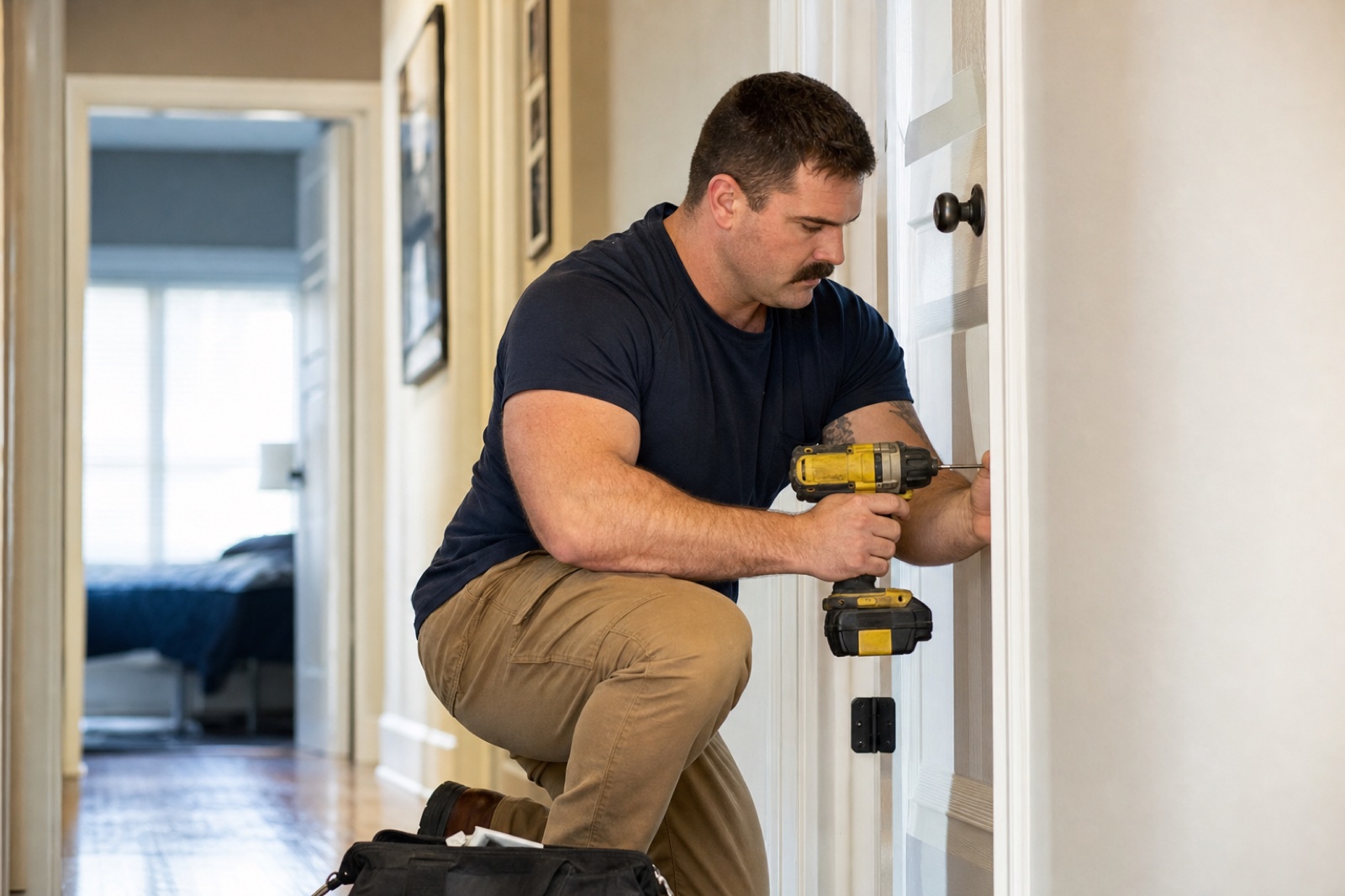 The trades are the most common firefighter side gig, and the days off line up with when the work happens. (Illustrative photo.)
Rideshare and delivery driving
Rideshare and delivery start faster than anything else here. You turn it on when you're free and off when you're not, so it bends around your shifts. The pay won't beat the trades, but there's no client to manage and no schedule to keep. As you'll see below, the driving itself is where a big tax deduction hides.
Real estate and home inspection
Showings and inspections happen on weekdays, which is when you're off. Firefighters tend to do well here because people trust them, and the work rewards someone dependable. It takes a license and some ramp-up, but the ceiling is high.
Personal training and CPR or first-aid instruction
You already know fitness and you already know emergency medicine, so both of these are short hops from skills you have. CPR and first-aid classes pay well per session and stay in constant demand from schools, daycares, and businesses that need certified staff.
Photography and videography
Weddings, events, and real-estate shoots land on weekends and weekdays you can cover. It's a build-your-own-client gig with gear costs up front, but it scales, and the editing fits a shift's downtime.
Reselling and e-commerce
You might flip items, run an Etsy shop, or open a small Amazon store. The work is yours to schedule, you can do most of it from home, and it grows on its own time. Good for someone who'd sooner build something quiet than show up at a job site.
EMS side work and dispatching
Your training is the qualification. Picking up EMT shifts or dispatch work uses what you do every day, and departments and ambulance services often run short-handed. The schedule can be flexible, and the learning curve is close to zero.
The tax move that lets you keep almost all of it
Most side-job lists stop at the gigs. But earning the money is only half of it; keeping it is the other half. Here the tax code helps: a side gig lets you write off costs that your firefighter paycheck never could.
First, the 1099 part, in plain English
You might be thinking, "I don't have a business." You do, in the eyes of the IRS, the moment a side gig pays you. Here's how that works.
When a side gig pays you as a "1099 worker," it means whoever pays you hands over the full amount and takes no taxes out. No withholding, no benefits. To the IRS, that makes you your own boss, a business of one.
You didn't file paperwork, form an LLC, or print business cards. The moment someone pays you on a 1099 instead of a W-2, you're running a business, and businesses get to write off their costs. That single fact unlocks the write-offs below.
Some side gigs let you pick how you're paid: on a company's payroll as a W-2 employee, or as a 1099 contractor. If you can take it as a contractor, that's the route that unlocks the write-offs. In practice, you invoice your customers and they pay you the full amount, instead of going on a payroll. You can't relabel a real payroll job, since the IRS goes by how the work actually runs, but your own weekend handyman business is the textbook contractor case.
One honest trade-off comes with it. At your firehouse job, you and the department each pay half of your Social Security and Medicare tax. On 1099 income, you cover both halves yourself. It's called self-employment tax, and the simple way to handle it is to set aside 25 to 30% of your profit as you go, so the bill is funded when it comes due.
That sounds like a lot, but here's what makes it worth it: the two write-offs below shrink the income you're taxed on in the first place, and for a side gig they usually win.
The home office: a deduction your paycheck can't touch
Your firefighter salary gets you nothing here. The IRS is blunt about it: "Employees are not eligible to claim the home office deduction." But the deduction follows the business, not the paycheck. The day your gig pays you on a 1099, a spare room can start lowering your taxes.
 A spare room you use only for the business can qualify for the home office deduction. (Illustrative photo.)
There's one rule that matters, straight from the IRS: you have to use the space "exclusively" and regularly for the business. A spare room where you do the books and the scheduling counts. The kitchen table, where the family also eats, does not. One family movie night in the office and the room fails the test for the year.
Tradespeople often think they can't claim a home office, because their real work is at job sites. They can.
IRS Publication 587 lets you qualify on the office work alone. The room counts if you use it only for tasks like billing customers and keeping records, and it's the only place you handle them. So the handyman who bills and schedules at a home desk qualifies, even though he swings the hammer across town.
You can figure the deduction two ways. The simplest is the IRS's simplified option: $5 per square foot, up to 300 square feet. A 150-square-foot spare room is a clean $750 deduction with no receipts to dig up, and the cap works out to $1,500. The other way, called the actual method, deducts your office's share of real housing bills like rent, utilities, and insurance. It takes more work but often pays more if you rent or carry a mortgage. Our budget template runs the home office math both ways if you want to compare.
One limit rides along, and it's why a side gig can't make your whole income tax free: the deduction can't be bigger than what the gig earns. It lowers the side-gig income, not your firefighter salary. But on a real side gig, it can still wipe out a serious chunk of the profit.
The mileage: 72.5 cents for every business mile
This one matters most for firefighters, because so many of these gigs involve driving. For 2026, the IRS set the business mileage rate at 72.5 cents a mile. Every mile you drive for the gig comes off your taxable income at that rate: supply runs, deliveries, the drive to a client's house.
The home office helps a second way. When it's the main place you run the business from, the IRS lets you count the drive from home to a job site as a business mile (Publication 587). For most people that drive is a non-deductible commute; for you it counts, and for a contractor driving to job sites all week, it adds up fast. The last column below uses a 22% tax bracket, a common middle rate; yours may run higher or lower.
| Business miles you drive for the gig in a year | Deduction at 72.5 cents | Tax saved at a 22% rate |
|---|---|---|
| Weekends only (5,000 miles) | $3,625 | $798 |
| Most off days (12,500 miles) | $9,063 | $1,994 |
| Driving is the whole gig (25,000 miles) | $18,125 | $3,988 |
The one mile that never counts is your drive to the firehouse. That's your commute to a W-2 job, side gig or not.
What it looks like all together
Say you run a weekend handyman business and clear $8,000 in a year on 1099s. You do the books in a 150-square-foot spare room, and you drive 4,000 miles to job sites and the hardware store. Here's the difference the write-offs make:
| $8,000 handyman side gig | Without the write-offs | With them |
|---|---|---|
| You earned | $8,000 | $8,000 |
| Home office (150 sq ft, simplified) | $0 | −$750 |
| Mileage (4,000 business miles) | $0 | −$2,900 |
| Income you actually pay tax on | $8,000 | $4,350 |
Same work either way. The spare room and the miles took $3,650 off the income you're taxed on, and that's before the cost of materials, tools, and supplies, which are deductible too. Track those and the taxable number drops further. This is why a 1099 side gig, run right, lets you keep almost all of what it pays.
The whole playbook comes down to four habits:
- Get paid as a 1099 contractor, not on a company payroll.
- Use one room at home only for the business, and nothing else.
- Log every business mile you drive, with the date it happened.
- Save every receipt for the materials, tools, and supplies you buy.
The catch is records. Every one of these write-offs needs proof: a mileage log with dates, and the receipts behind your expenses.
We handle that part at Shoeboxed. Snap a photo of a receipt in the app, or mail us a pile in a prepaid Magic Envelope. Our team scans it while our software pulls the vendor, date, and total.
Your mileage and your receipts land in one place, so at tax time you hand over real numbers instead of guesses. There's a free home office calculator too, if you want your own number in about a minute.
Federal or wildland firefighter? Read this first
Everything above is the regular tax picture for a city or county firefighter. Federal firefighters have one more thing to watch.
If you're on a Forest Service wildland crew, for instance, federal ethics rules limit how and when you can earn outside income. That's true of anything tied to the job itself. It's not a wall, but you need to know the lines before you sell anything.
My son Graham is doing his first wildland fire season this summer. He wrote up what those rules say, in plain English, from the inside. If that's you, start with his breakdown: side jobs and the rules for wildland firefighters.
Keep the money side painless
The side gig is the fun part. The shoebox of receipts and the "how many miles did I drive?" guesswork at tax time is the part that makes people quit. It doesn't have to be that way. Keep a running mileage log and snap every receipt the day you get it, and the deductions on this page take care of themselves.
It's the whole reason Shoeboxed exists. You get receipts to us five ways, whichever is easiest:
- Snap a photo in the app the moment you're handed a receipt.
- Mail a pile in a prepaid Magic Envelope and let us scan it.
- Forward an emailed receipt to your Shoeboxed address.
- Let our Gmail plugin grab emailed receipts on its own.
- Upload or drag and drop on the website.
Turn your side gig into money kept. Shoeboxed tracks your mileage and scans your receipts so the home office and mileage write-offs are ready at tax time, not a scramble in April. See how it works.
Frequently asked questions about side jobs for firefighters
What are the best side jobs for firefighters?
The trades are the most common and pay the best over time: contracting, HVAC, electrical, plumbing, and handyman work. Many firefighters already have the skills, and the days off line up with the work. After that, rideshare and delivery, real estate, personal training and CPR instruction, photography, reselling, and EMS or dispatch shifts all fit the schedule well.
How do firefighters make money on the side?
They use their two days off after each shift for daytime work, often with skills they already have, like the trades, fitness, or emergency medicine. The schedule is the advantage: blocks of weekday time when the rest of the world is open for business.
Do I have to pay taxes on a firefighter side job?
Yes. If your net earnings from self-employment are $400 or more, you have to report it, and you'll owe self-employment tax on the profit. The upside is that a side gig paid on a 1099 lets you deduct business costs your paycheck can't, like a home office and your mileage, which lowers the income you pay tax on.
Can a firefighter claim a home office for a side business?
Usually yes, if the gig pays you as a self-employed contractor and you use a space at home regularly and only for that business. It can still count even when the real work happens at job sites, as long as the home space is where you do your admin work. Employees can't claim it, but a 1099 side business can. Check your own situation with a tax preparer.
What's the mileage deduction for a side gig in 2026?
72.5 cents for every business mile you drive, which covers supply runs, deliveries, and trips to clients. If your home office is your principal place of business, the drive from home to a job site counts too. Your commute to the firehouse never does.
Final thoughts
The 48 hours off after a shift is an asset most workers don't have. Spend some of it on a gig that fits, get paid on a 1099, and keep a home office and a mileage log, and you turn that time into income the tax code lets you keep most of. Earn it on your days off, and keep it with good records. That's the whole game.
About the author. I'm Doug. I bought Shoeboxed in late 2025 with an SBA loan after fifteen years of running other people's companies as CEO. I used Shoeboxed myself back in 2010 at a previous job and called it magical even then. Small business owners deserve every dollar they're legally entitled to keep. That goes for everyone running something on the side of a day job too. It's why I bought Shoeboxed and work to make it better.
Sources
- Langford et al., "Influence of Secondary Job Status on Firefighters' Physical Activity Level and Training Load," International Journal of Exercise Science, 2023, on the 61% second-job figure.
- IRS, 2026 standard mileage rate (72.5 cents per business mile).
- IRS, Simplified option for the home office deduction ($5 per square foot, up to 300 square feet; deduction limited to business income).
- IRS, Home office deduction basics (employees not eligible; exclusive and regular use).
- IRS, Publication 587, on the administrative-use test and transportation from a home principal place of business.
- IRS, Independent contractor defined, on how the IRS tells a contractor from an employee.
- IRS, Self-employed individuals tax center ($400 filing threshold).
30 Seconds Could Save You Thousands on Taxes
Self-employed? Get an instant, personalized tax-savings estimate.




 4.4 / 5 on