What Is a Tax Receipt? Definition, Examples, and Which Ones to Keep
A tax receipt is any receipt you keep to back up a number on your tax return. See a labeled example, the two meanings of the term, the donation $250 rule, and how long to keep yours.


Updated June 2026.
A tax receipt is any receipt you keep to back up a number on your tax return. The term covers two separate things. For a business, it's a regular store or vendor receipt you hold onto to prove an expense you deducted. For a donor, it's the written acknowledgment a charity gives you for a gift. Same two words doing two jobs, and this guide covers both.
You probably landed here for one of two reasons. Maybe you run a small business and have a shoebox of store receipts your accountant keeps asking about. Or maybe you wrote a $300 check to your church and want to know what paper you need to deduct it. Both count as a tax receipt. Below, I'll sort out which one you're after and tell you exactly what to keep.
I am Doug. I own Shoeboxed, and since 2007 we have scanned over 57 million receipts for more than 552,000 small businesses. So when it comes to which receipts are worth keeping for taxes, I have a pile of real numbers to show you, not just opinions.
What a tax receipt is
Start with the business meaning, because that's the one most small business owners are after. A tax receipt isn't a special document the store prints. It's a plain receipt you decided to keep because it backs up money you're claiming on your taxes. Most of them are ordinary purchase receipts, the slip a store or vendor hands you when you buy something.
Think about a lunch receipt. Toss it and it's just paper. File it because you met a client over that lunch and it's a tax receipt. Nothing on it changes. What changes is that you kept it.
Here's a regular office-supply receipt with the parts the IRS cares about labeled.
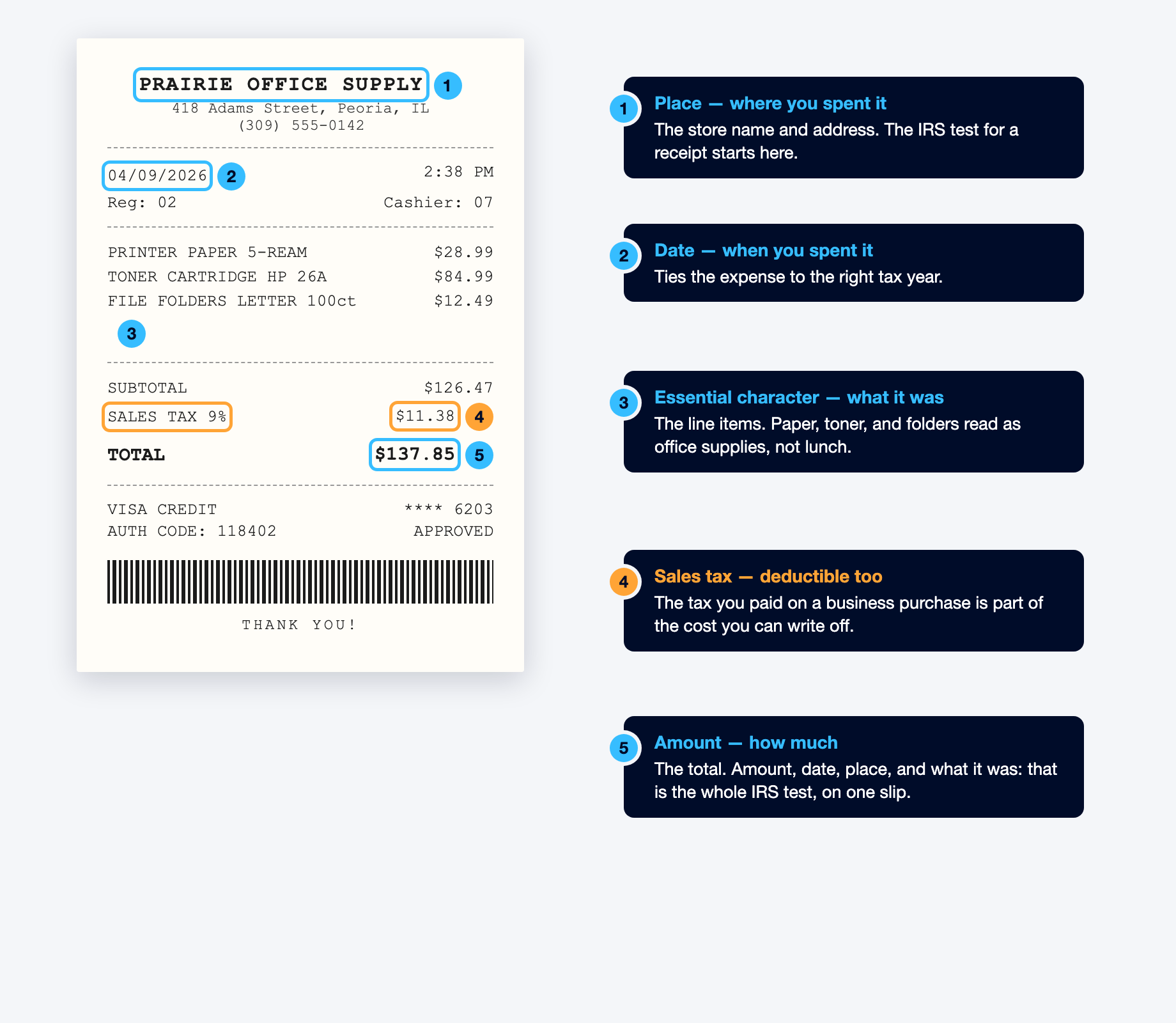 A plain store receipt, read the way the IRS reads it. Place, date, what it was, and the amount, all on one slip. (Prairie Office Supply is made up for the example.)
Those labels aren't my invention. They line up with the test the IRS spells out in Publication 463:
"Documentary evidence will ordinarily be considered adequate if it shows the amount, date, place, and essential character of the expense."
IRS, Publication 463
Amount, date, place, and essential character. That last phrase just means "what it was." A receipt that shows you spent $137.85 at an office store on April 9 for paper and toner answers all four. That's a tax receipt. The exact thresholds for when the IRS requires one, and what to do when a receipt is missing, live in our guide to IRS receipt requirements.
The two meanings of "tax receipt"
The word trips people up because it points at two separate pieces of paper. Here's the split, side by side.
| Business tax receipt | Donation tax receipt
---|---|---
What it is | A regular receipt you keep to prove an expense | A charity's written acknowledgment of your gift
Who hands it to you | The store, the vendor, the register | The nonprofit you gave to
It backs up | A business deduction | A charitable deduction
Who keeps it | Business owners and the self-employed | Anyone who donates and itemizes
There's a third thing people sometimes mean: a "taxpayer receipt," the breakdown of where your federal tax dollars get spent. That's a civics tool, not a document you keep. It's not what this guide is about, so set it aside. The rest of this page covers the two that end up in your files.
Which of your everyday receipts are tax receipts
If you run a business, the honest answer is "more of them than you're keeping." A tax receipt can be the fuel you bought between job sites, the lunch where you talked shop, the printer paper, the hotel on a work trip, the software subscription. None of those look special. They become tax receipts the moment you file them against a deduction.
I can show you what that looks like across real businesses. Customers sent us 3.5 million receipts since January 2024. When we line them up by category, one pile dwarfs the rest, and it's the wrong one.
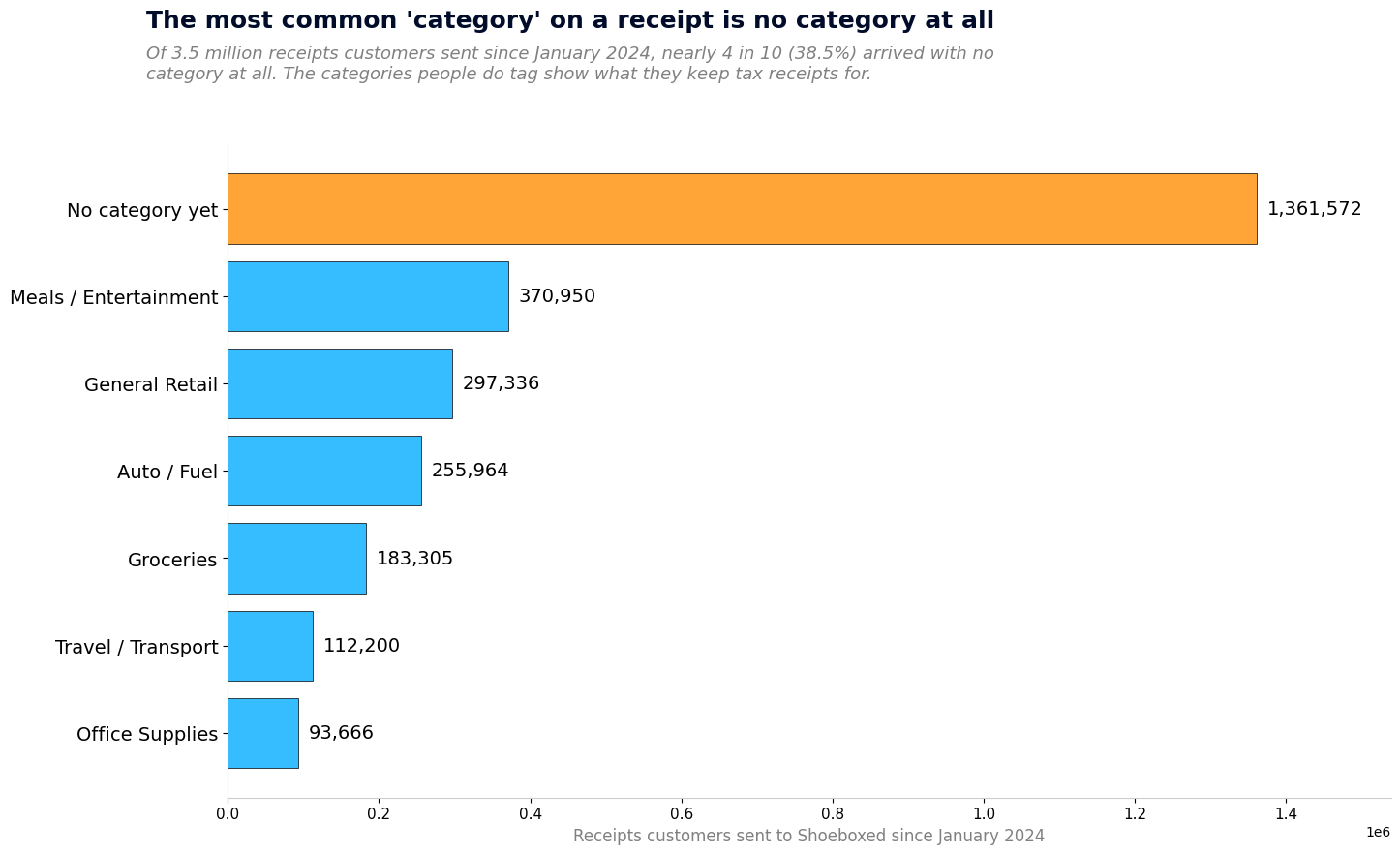 Of 3.5 million receipts customers sent us since January 2024, more than a third arrived with no category at all. The bars below it show what people keep tax receipts for.
More than a third came in with no category at all. People keep the paper and never sort it. The categories they do tag tell the real story of a tax receipt: meals, general retail, fuel, groceries, travel, office supplies. Those are the everyday purchases a business writes off.
The clearest proof that a tax receipt is just a choice you make: our customers tag receipts "Deductible" and "Personal" with their own hands. The deductible pile is the tax receipts. The personal pile is the coffee you bought on a Sunday. The receipt looks identical either way. You decide which pile it lands in.
One tax-receipt rule surprises people: a gift you buy for a client is capped at $25 per client a year as a deduction, no matter what you spent. The whole story is in our gift receipt guide. For a fuller map of every receipt type and what each is good for, see types of receipts.
Donation tax receipts and the $250 rule
Now the other meaning. A donation tax receipt is the paper a charity gives you so you can deduct your gift. The size of the gift decides what you need.
For a cash gift under $250, you don't need much. A bank record or a simple note from the charity does the job. Publication 1771 puts it plainly:
"A written communication includes a receipt, a letter, and an email."
IRS, Publication 1771
Cross $250, and the rules tighten. Now you need a real acknowledgment from the charity, and you need it in hand before you file. Same Publication 1771:
"Donors are responsible for obtaining a contemporaneous written acknowledgment from a charitable organization for any single monetary contribution or noncash contribution valued at $250 or more before donors can claim a charitable deduction on their federal income tax returns."
IRS, Publication 1771
That acknowledgment has to show a few things: the charity's name, the cash amount, a description of any non-cash gift, and whether you got anything back for your money. Here's the practical version.
One thing that trips people up: the $250 line is per gift, not per year. Publication 1771 says small gifts don't get added together, and it uses the exact example of weekly church offerings under $250. So a $20 bill in the collection plate every Sunday never crosses the line, even if your giving for the year tops $250.
| Your gift | What you need to keep |
|---|---|
| Cash gift under $250 | A bank record, or a receipt, letter, or email from the charity |
| Any single gift of $250 or more | A written acknowledgment from the charity, in hand before you file |
| You gave more than $75 and got something back | A statement from the charity showing the deductible part |
That last row catches people. If you paid $200 for a charity dinner and the meal was worth $60, you can only deduct $140, and the charity has to tell you so in writing. Publication 1771 requires that statement any time you give more than $75 and get goods or services in return. If you run the nonprofit side of this and need to send these out, our donation receipt template for nonprofits has you covered.
Dropping off a bag of clothes or an old couch works a little differently. That's a non-cash gift, so the receipt describes what you gave, not a dollar value, and you set the value yourself. The Goodwill donation receipt guide walks through exactly what to keep when you donate goods.
One more tax receipt people forget: your charity miles
Here's a tax receipt with no paper at all. When you drive for a charity, those miles are deductible at 14 cents each, right alongside whatever you gave. Publication 526 sets the rate: "you can use a standard mileage rate of 14 cents a mile to figure your contribution." The drive to drop off a carload at the donation center, the trip to your volunteer shift, the miles for your church, they all count and they add up over a year.
There's one rule, and it's the easy part: keep a record of the miles. Publication 526 says you "must keep reliable written records of your car expenses." No log, no deduction, and a tax preparer can confirm which of your trips qualify.
That mileage log is the receipt, and it's the easiest one to lose because nobody hands it to you. Shoeboxed tracks your miles right next to your receipts, so a charity drive becomes a logged trip with a date, in the same account as the rest of your proof.
How long to keep your tax receipts
Whichever kind you've got, the next question is how long to hang on. The answer is set by how far back the IRS can look at your return:
| Your situation | Keep records for |
|---|---|
| A normal tax return | 3 years |
| You left off more than 25% of your income | 6 years |
| You claimed a loss for a bad debt or worthless stock | 7 years |
My rule for most small businesses: keep everything seven years and stop thinking about it. Thermal paper is the real trouble. Store receipts print on it, and the ink fades to a blank slip in a year or two, sometimes faster in a hot car. A faded receipt proves nothing. Get the image saved before the ink gives up, and the seven-year question takes care of itself. The IRS spells out which documents prove your income, too, and your bank transaction receipts and receipt books are on its list in Publication 583.
How to keep your tax receipts so they're there at tax time
Getting a tax receipt is never the hard part, because the store hands you one and the charity mails one. The hard part is having that exact slip, readable, two or three Aprils later when your accountant asks. That's the job Shoeboxed does.
Send us a receipt and we keep the actual image, then pull out the vendor, the date, and the amount, the fields the IRS wants to see. You can get receipts to us five ways:
- Snap a picture in the app before the slip leaves your hand.
- Drop the paper in a prepaid Magic Envelope and mail it to us.
- Forward an emailed receipt to your Shoeboxed address.
- Let our Gmail plugin pick up emailed receipts on its own.
- Upload or drag and drop on the website.
Everything lands in one searchable account, sorted into categories, ready to become an expense report your accountant can use. And if you ever leave, you can download all of it.
Never lose a receipt again. Join the small businesses that scan receipts, sort them into categories, and build IRS-ready expense reports with Shoeboxed. See how it works.
For the bigger system your tax receipts fit into, here's our guide to receipt organization and management.
Frequently asked questions about tax receipts
What is a tax receipt?
Any receipt you keep to back up a number on your tax return. For a business, it's a regular store or vendor receipt you hold onto to prove an expense you deducted. For a donor, it's the written acknowledgment a charity gives you for a gift.
Is a tax receipt the same as a regular receipt?
It's the same piece of paper. A receipt becomes a "tax receipt" the moment you keep it to support a deduction. Nothing printed on it changes. The store receipt you toss and the one you file for taxes are identical until you decide to keep one.
What does a tax receipt need to show?
For a business expense, the IRS wants the amount, the date, the place, and what it was for. A normal store receipt shows all four. For exact rules on when a receipt is required, see our IRS receipt requirements guide.
Do I need a receipt for a charitable donation?
Yes, to deduct it. For a cash gift under $250, a bank record or a note from the charity works. For any single gift of $250 or more, you need a written acknowledgment from the charity before you file your return.
How long should I keep my tax receipts?
Three years for a normal return, since that's how far back the IRS usually looks. Keep them six years if you under-reported income by more than 25%, and seven if you claimed a bad-debt or worthless-stock loss. For most small businesses, keeping everything seven years is the simple rule.
Are digital tax receipts okay, or do I need the paper?
A clear digital copy is fine. The IRS accepts scanned and photographed receipts as long as they're legible and show the same details as the paper. Saving a digital copy also beats letting a thermal receipt fade to nothing in a drawer.
Final thoughts
A tax receipt is a small thing with one job: backing up a number you put on your return. The business version is any receipt you chose to keep. The donation version is the acknowledgment a charity owes you, and the $250 line decides how formal it has to be.
The paper won't keep itself, and that's the part we handle. Scan your receipts, file them, and the records will outlast the ink.
About the author. I'm Doug. I bought Shoeboxed in late 2025 with an SBA loan after fifteen years of running other people's companies as CEO. I'd used Shoeboxed myself back in 2010 at a previous gig and called it magical even then. I use it daily now. Small business owners deserve every dollar they're legally entitled to keep, which is why I bought Shoeboxed and work hard to make it better.
Sources
- IRS, Publication 463, on what counts as adequate documentary evidence for a business expense.
- IRS, Publication 1771, on the $250 written-acknowledgment rule, what the acknowledgment must contain, and the $75 quid pro quo statement.
- IRS, Publication 583, on the documents that prove your gross receipts.
- IRS, How long should I keep records, on the 3, 6, and 7 year windows.
30 Seconds Could Save You Thousands on Taxes
Self-employed? Get an instant, personalized tax-savings estimate.




 4.4 / 5 on