Free Lawn Care Business Expenses Spreadsheet (With a Balance Sheet)
A free lawn care business expenses spreadsheet that maps every cost to its Schedule C line. Includes a landscaping balance sheet, home office log, and mileage log. No email required.

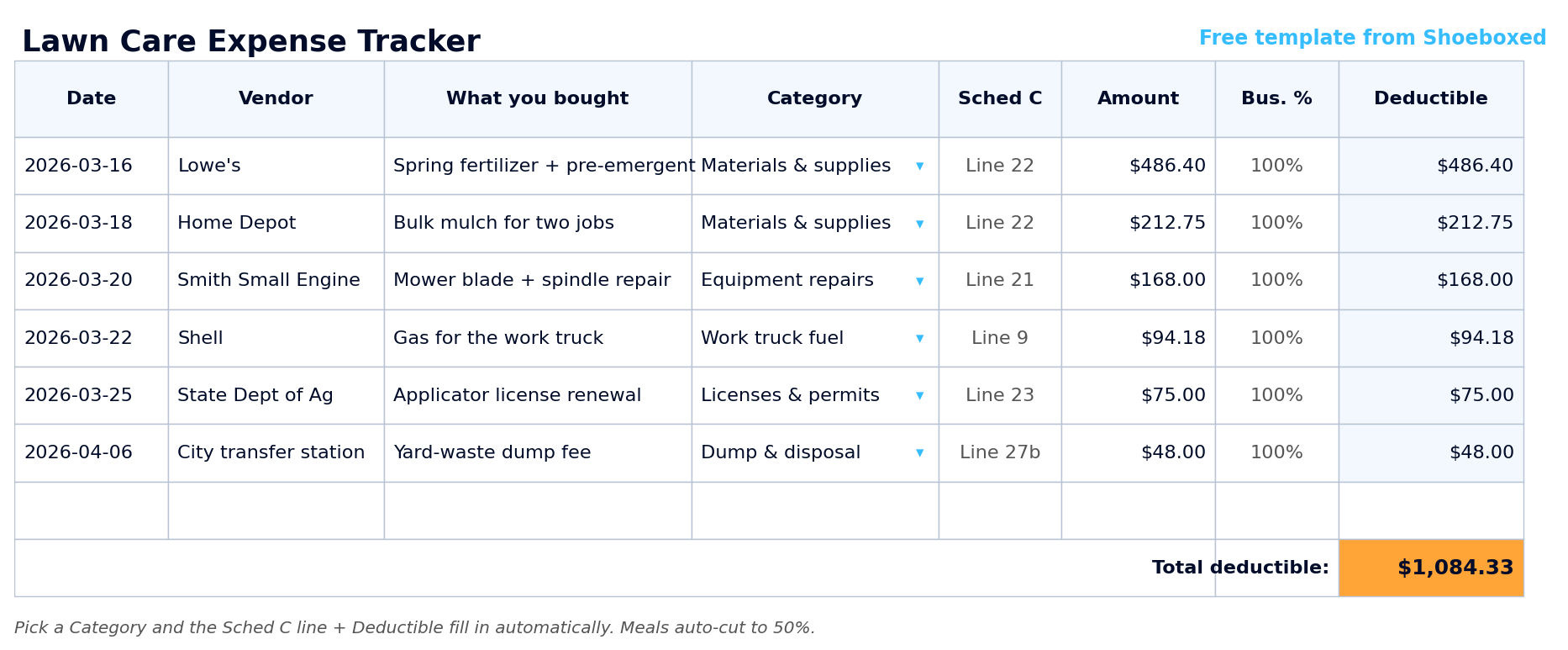
If you want a lawn care business expenses spreadsheet that does more than hold a list, here's a free one I built, no email required. Copy it to your Google Drive or download the Excel file. Type one row per receipt, pick the category, and the sheet fills in the Schedule C line and the deductible amount for you.
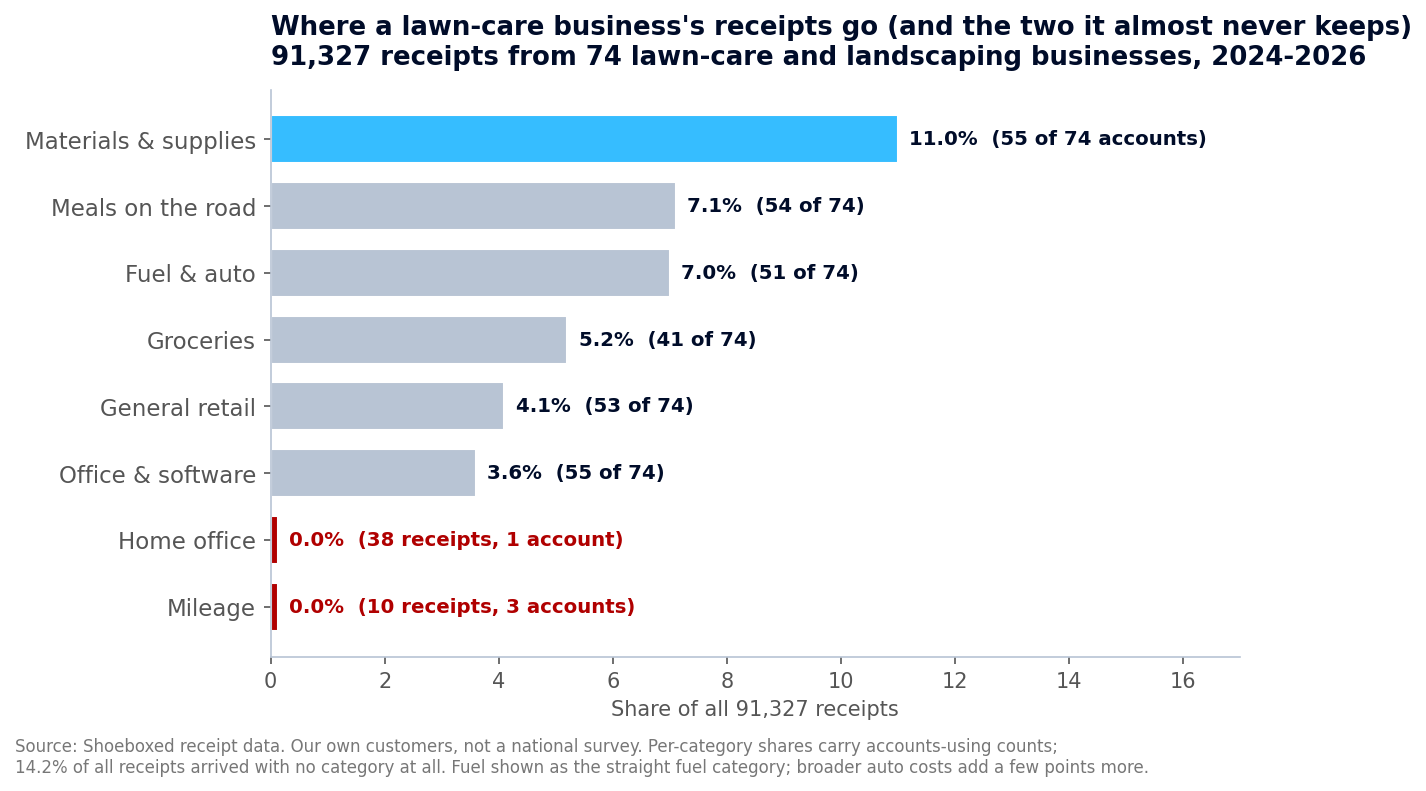
Before I built the columns, I pulled every receipt from the lawn-care and landscaping businesses in our archive, 91,327 of them across 74 companies. Two of the biggest deductions a lawn-care business can take barely showed up in any of them. I'll show you both below, because together they can be worth thousands of dollars a year, and the spreadsheet gives each its own tab.
I run Shoeboxed, a receipt-scanning company that has turned shoeboxes of paper into tax records since 2007. Lawn-care businesses are a hard test of a receipt system. You buy supplies at four stores in one morning. You pay some crew in cash. And you drive all day between jobs while the truck quietly racks up the deduction nobody writes down. If your business isn't lawn care or landscaping, the small business expense spreadsheet is the general version, our Google Sheets expense tracker is the build-your-own, and the 1099 expense tracker fits a solo contractor. This page is for the people who mow, plant, and haul.
"Across 91,327 receipts from 74 lawn-care and landscaping businesses, Shoeboxed found mileage logged on just 10 receipts and home office on 38: the two biggest deductions a route-driven, home-based lawn business can take are the two it almost never tracks."
Shoeboxed customer data, June 2026
Get the lawn care expense spreadsheet
Copy the template to my Google Drive →
Prefer Excel? Download the .xlsx file and open it in Excel, Numbers, or Google Sheets.
You get six sheets in one workbook:
- Lawn Care Expense Tracker. One row per receipt. Pick a category from the dropdown and the sheet fills in the Schedule C line and the deductible amount. It even trims your meal write-offs to the 50% the IRS allows.
- Balance Sheet. A plain-English landscaping balance sheet, the one page a bank or bonding company asks for. Overwrite the example numbers with yours and it balances itself.
- Schedule C Summary. Your totals rolled up by tax line, the one page your accountant wants.
- Home Office Log. Both ways to figure the home office deduction, with a quick check that your space qualifies.
- Mileage Log. Four fields per trip for the truck that runs your routes, multiplied by the IRS rate for you.
- Bonus tab. 25% off Shoeboxed, on any plan, in case you'd like us to do the typing.
I locked the categories to a dropdown built for lawn care. Your fertilizer, your mower repair, and your dump fee each land in their own column instead of a junk drawer. The how-to instructions sit at the top of the first tab, so you don't have to remember any of this.
If you only do one thing on this page, copy the template. The rest of this article explains the rules built into it, and two of them put real money back in your pocket.
What 91,327 lawn care receipts say about where the money goes
Those receipts come from 74 lawn-care and landscaping businesses in our archive, going back to June 2024. These are our customers, not a national survey, so read the numbers as a real stack of paper, not a census.
The spending spreads out more than you'd guess. Materials and supplies, the fertilizer, mulch, seed, and sod that go into a job, led the pile at about 11% of all receipts, and they showed up across 55 of the 74 businesses. Fuel and meals on the road came next, each around 7%, and the fuel showed up across 51 of them. Then office and software costs at 3.6%, and a long tail of everything else.
One thing surprised me when I sorted the sellers. Almost nobody buys from a wholesale landscape distributor. The receipts come from Home Depot, Lowe's, Amazon, Walmart, and Costco, the same stores you'd shop at on a Saturday. Lawn-care pros stock the truck at the big-box on the way to the first job, and that's exactly how the tracker expects you to log it.
That's why the sheet gives the work its own columns. Fertilizer and mulch point at Schedule C Line 22 with the supplies, mower repairs point at Line 21, and the truck's fuel points at Line 9, where your accountant expects to find them. You're not guessing which column the Lowe's run belongs in, because the dropdown already knows.
The receipts that don't exist: almost no mileage, almost no home office
Here's what jumped out at me when I sorted the pile. Mileage showed up on 10 receipts out of 91,327, from just 3 of the 74 businesses. Home office showed up on 38, from a single business. For a trade that drives all day and runs the books from a spare room, those two numbers should be huge. They're rounding errors.
Meanwhile, the same businesses saved 6,364 fuel receipts. They're keeping the gas-pump slip from every fill-up but not writing down the miles the truck drove on that gas. That's the part that costs them, because for a lawn-care truck the miles are usually worth far more than the fuel.
These costs never arrive as paper. No cash register prints a receipt for a mile, and the spare bedroom doesn't email you a monthly statement. Your receipt pile will never remind you to claim either one, so the deduction quietly walks out the door every April.
That's why the workbook gives mileage and home office their own tabs. Out of 74 businesses, almost none logged a mile or a home-office cost, and that money never comes back on its own. The next two sections cover both.
Your truck, your miles, and the deduction most lawn care pros miss
The single biggest deduction hiding in your business is probably the miles on your truck, and our data says you're almost certainly not tracking them.
Good news for lawn care: your work truck most likely qualifies for the standard mileage rate, the famous cents-per-mile deduction. Here's the 2026 rate straight from the IRS:
"Beginning Jan. 1, 2026, the standard mileage rates for the use of a car, van, pickup or panel truck will be: 72.5 cents per mile driven for business use, up 2.5 cents from 2025."
IRS Publication 463 writes that rate for vehicles under 6,000 pounds, and most lawn-care pickups and vans fall under that line. (A loaded dump-bed rig can run heavier, so check the sticker inside your driver's door.) If your truck qualifies, you log the miles and multiply by 72.5 cents, and you skip saving every gas and oil receipt for it.
Picture a normal week. You drive between job sites all day, run to Lowe's for mulch, swing by the bank, and head home. Say that adds up to 12,000 business miles in a year, which is an easy number for a route-based business to hit. At 72.5 cents a mile, that's $8,700 of your income the IRS can't tax you on, and not one of those miles leaves a paper trail. Depending on your bracket, that's well over a thousand dollars you keep. Add up your own miles and the number will probably surprise you.
The Mileage Log tab takes four fields per trip: the date, where you went, why, and the miles. If you don't want to keep it by hand, the mileage log template article walks through the easier ways, including letting our app log the drives for you.
How you lose the deduction: claiming the mile rate and the actual fuel receipts on the same truck. The IRS makes you pick one method per vehicle. For most lawn-care trucks the standard mileage rate wins, so log miles and leave the gas receipts out of it.
The home office a lawn care business can usually claim
If you do your quotes, your scheduling, your invoicing, and your books from one spot at home, the IRS probably owes you a home office deduction, and our data says you're not taking it.
There's an exception written for exactly your situation. You don't need a fancy office or a storefront. You need one place at home where the paperwork happens, and no other fixed office where you do that same work. A truck and a trailer aren't a fixed office, so for most solo operators the home desk is the only place the admin lives. The IRS calls this the administrative-functions exception. Publication 587 says your home office qualifies if:
"You use it exclusively and regularly for administrative or management activities of your trade or business. You have no other fixed location where you conduct substantial administrative or management activities of your trade or business."
The simplest way to claim it is the IRS's simplified option: $5 a square foot, up to 300 square feet. A 200-square-foot spare room is a clean $1,000 deduction with no receipts to dig up. You can stop there, but the simplified method caps at $1,500. The actual method counts the real share of your rent or mortgage, utilities, and insurance that the office takes up, so you'll likely save more with it if you rent or carry a mortgage. The Home Office Log tab figures both side by side so you can see which one wins.
Want the math done for you? Our home office calculator pulls your home's square footage from your address and runs the numbers in about thirty seconds. Type what it finds into the Home Office Log tab and you're done.

How you lose the deduction: using the space for anything personal. One family movie night in the office corner and the room fails the exclusive-use test. The garage where you park the mowers doesn't count either if the family car lives in there too. Keep the deducted space business-only.
Bookkeeping basics for a lawn care business
Nobody set up your books for you when you bought your first mower, so let me give you the short version. Good bookkeeping for a lawn-care business comes down to four habits, and none of them take an accounting degree.
Open a separate business checking account and card. Of the four habits, this is the one that matters most. When every business dollar runs through one account, your books practically write themselves, and a cash dump-fee or a Saturday Home Depot run is easy to defend. Mixing business and personal in one account is how good owners lose deductions they earned.
Tag receipts the week you get them, not next April. In our pile, about 1 in 7 receipts (14.2%) had no category at all. A charge you can't explain a year later is a charge you won't claim. The tracker's dropdown makes tagging a two-second job, so do it Friday with the radio on, not in a panic before the deadline.
Know cash versus accrual in one sentence. Cash basis means you count the money when it hits your account; accrual means you count a job when you bill it, even if the check shows up later. Most small lawn-care businesses use cash basis because it's simpler and matches how the money moves. Your CPA can tell you if you're better off switching.
Close the month in twenty minutes. Once a month, make sure every receipt is in, every category is filled, and the totals look right. That's the whole job. I learned to keep it that simple the hard way: until I bought Shoeboxed, I waited until the week before the deadline to do the books for my small side companies, usually messed something up, and then paid my CPA extra to untangle it. Twenty minutes a month beats a lost weekend in April every time. If you want a checklist, we wrote one in the monthly bookkeeping checklist.
The landscaping balance sheet, in plain English
A balance sheet is a snapshot of what your lawn-care business owns versus what it owes on one single day. The Small Business Administration calls it "the foundation of managing your finances." You'll need one the day you apply for an equipment loan, get bonded for commercial work, or sell the business.
It runs on one rule that always holds true:
Assets = Liabilities + Owner's Equity
Assets are what you own: the cash in the business account, the money customers still owe you for finished jobs (accountants call that accounts receivable), the fertilizer and parts on the shelf, and your mowers, trailers, and truck. Liabilities are what you owe: the credit-card balance, the bills you still owe suppliers (accounts payable), the equipment loan, and the truck note. Owner's equity is what's left over for you once the debts are paid, and the sheet figures it so the two sides always match.
Here's a quick example for a small lawn-care business:
| The one-day snapshot | Amount |
|---|---|
| Assets (truck, trailer, two zero-turn mowers, $18,500 cash) | $95,800 |
| Liabilities (equipment and truck loans) | $37,500 |
| Owner's equity (what's left for you) | $58,300 |
A banker reads those three numbers in about ten seconds and decides whether to write the loan.
The Balance Sheet tab in the workbook lays this out line by line for you, the way a loan officer expects to see it.
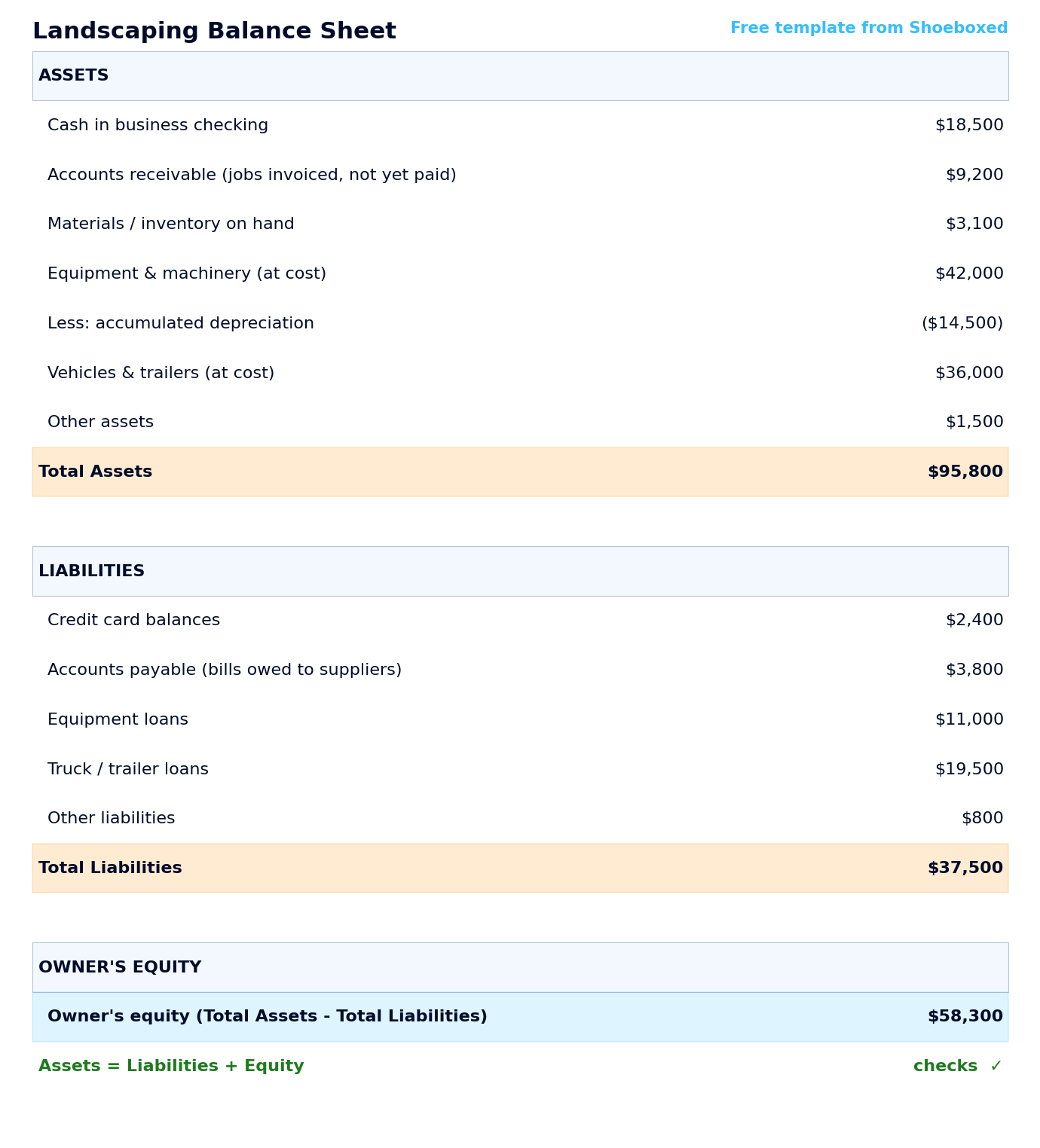
It ships with example numbers so you can see the shape, and you overwrite them with yours. List your truck, trailer, and mowers at what you paid, then let the tab subtract the depreciation you've already written off on your taxes, and put what you still owe on each one under liabilities. If you're buying a new truck with the loan you're applying for, it goes in as an asset at its price and the loan goes in as a liability for the same amount, so they cancel out until you start paying it down. The equity line and the balance check update on their own. Fill it out once a year, or right before you walk into the bank.
Every lawn care cost, mapped to its Schedule C line
You don't have to memorize any of this, because the sheet fills in the line for you. The table is here so you can see where your fertilizer, your mower repair, and your dump fee land.
| What you spent money on | Examples | Schedule C line |
|---|---|---|
| Materials & supplies | Fertilizer, mulch, seed, sod, pesticides | Line 22 |
| Small equipment & tools | Trimmers, blowers, hand tools | Line 22 |
| Equipment & machinery / Section 179 | Mowers, trailers, big equipment | Line 13 |
| Equipment repairs | Blades, parts, mower and trimmer service | Line 21 |
| Work truck fuel, oil & repairs | The truck's actual running costs | Line 9 |
| Vehicle & equipment insurance | Liability plus the truck policy | Line 15 |
| Licenses, permits & registration | Pesticide applicator license, business license, truck reg | Line 23 |
| Dump, landfill & disposal fees | Yard-waste runs to the transfer station | Line 27b |
| Subcontractor / crew labor | A hired day-laborer crew (1099) | Line 11 |
| Employee wages | W-2 crew pay | Line 26 |
| Advertising | Yard signs, truck wrap, Google and Facebook ads | Line 8 |
| Office, software & phone | Jobber, Service Autopilot, the cell plan | Line 27b |
| Rent | Yard or equipment storage lot | Line 20b |
| Meals (50%) | Eating out on lawn-care business | Line 24b |
| Equipment / truck loan interest | Interest on the note | Line 16b |
| Home office | The admin spot at home | Line 30 |
The tracker uses these exact lines. The IRS renumbers one now and then, so check yours against the Schedule C for your filing year.
One row deserves a hard look: the equipment on Line 13. A new zero-turn mower or an enclosed trailer often qualifies for Section 179, which lets you write off the full cost the first year instead of spreading it out over several. That can swing your tax bill by thousands the year you buy, so flag those receipts and ask your CPA before you file.
Four mistakes that cost a lawn care business the deduction
I've watched good lawn-care owners hand money back to the IRS over small slips, and here are the four I see most.
Skipping the miles. This is the big one, because our data shows lawn-care businesses log almost no mileage even though they drive all day. How you lose the deduction: every untracked business mile is 72.5 cents you'll never get back. Log the routes, the supply runs, and the bank trips.
Receipts that never get a category. In our pile, about 1 in 7 receipts sat with no category at all. How you lose the deduction: a charge you can't explain is the first thing the IRS throws out in an audit. Tag receipts the week you get them.
Running the business out of the cash drawer. Lawn care runs on cash, and a cash dump fee or a day-laborer payment with no paper trail is hard to defend. How you lose the deduction: you can't prove the cash buy was for the business, so you skip claiming it and overpay. Run a separate business account and ask for a receipt even when you pay cash.
Letting thermal receipts cook in the truck. Gas-pump and big-box receipts print on thermal paper, and thermal paper baking on a hot dashboard fades to blank within months. How you lose the deduction: the proof goes gray before the return is even due. Snap a photo the day it prints, and if one already vanished, the lost receipt guide shows how to rebuild the record. The IRS keeps the right to look back three years after you file, and a faded slip proves nothing.
The easy way: let us do the typing
I stand behind the sheet, but I'll be straight with you about the catch: somebody still has to type every receipt into it. Our pile shows what happens when that somebody is busy running a crew all summer, because 1 in 7 receipts never got tagged.
That's the whole reason Shoeboxed exists. We do the typing for you, whether you snap a photo with the app, forward an email receipt, sync your Gmail, or stuff a season of paper into our postage-paid Magic Envelope. Our team in Durham scans the paper, and our software pulls out the date, total, vendor, and category, so every cost lands in your account already sorted, with the same spelling every time. We've been doing this since 2007, and more than half a million businesses have sent us their receipts.
The mileage piece is my favorite for lawn care. Put the app on your phone and it tracks your drives by GPS in the background, then texts you the list at the end of the day. Reply with which ones were business, and a tax-ready log of your routes and supply runs builds itself: the date, the miles, the IRS rate, the total. The miles that showed up on just 10 receipts in the whole pile get captured without anyone keeping a notebook in the glovebox.
Either way, the template is yours, no signup and no strings. Pricing starts at $9 a month, and Shoeboxed Pro runs $29 a month with a 30-day money-back guarantee. Scan a season of receipts, and if it isn't for you, we refund the money. (Prefer to start on your phone? The mobile app comes with a 7-day free trial, no payment up front.)


Copy the sheet, claim the miles on the truck that runs your routes and the home office most owners forget, and you'll keep more of what the season earns than most lawn-care businesses ever do.
Frequently asked questions
What expenses can a lawn care business write off? Most of what it takes to run the work: materials like fertilizer, mulch, and seed; mower and equipment repairs; the work truck's fuel and miles; insurance; licenses and permits; dump fees; advertising; crew pay; software; and a home office if you qualify. The free spreadsheet maps each one to its Schedule C line for you.
Can a lawn care business deduct mileage? Usually yes, and it's often the biggest deduction you've got. Most lawn-care trucks and vans weigh under 6,000 pounds, so they qualify for the standard mileage rate, which is 72.5 cents per mile for 2026. Log the miles you drive between jobs, on supply runs, and to the bank. You pick either the mileage rate or the truck's actual costs, not both, on the same vehicle.
What is a landscaping balance sheet? It's a one-day snapshot of what your business owns (cash, equipment, the money customers owe you) versus what it owes (loans, credit cards), with the difference being your owner's equity. Banks and bonding companies ask for one. The free workbook includes a Balance Sheet tab that fills in the equity and balances itself once you enter your numbers.
How do I do bookkeeping for a landscaping business? Open a separate business account, tag every receipt to a category the week you get it, pick cash or accrual accounting (most go with cash), and spend twenty minutes once a month making sure everything's in and the totals look right. The spreadsheet on this page handles the tagging and the totals.
Is the lawn care expense spreadsheet free? Yes, with no email, no signup, and no trial. Copy it to your Drive or download the Excel file, and it's yours. The only pitch is a bonus tab with 25% off Shoeboxed, on any plan, if you'd like us to do the typing.
How long should I keep lawn care receipts? Three years from the date you filed, in the normal case, and longer in a few situations like under-reporting income. Keep a photo of each receipt and you can toss the fading paper.
About the author
I'm Doug. I bought Shoeboxed in late 2025 with an SBA loan and 5% down, so I run a small business and sweat the same receipts and the same tax bill you do. I write these guides because the surest way to grow Shoeboxed is to help people keep more of what they earn, and because the folks who keep my own yard from going feral deserve to keep more of theirs.
30 Seconds Could Save You Thousands on Taxes
Self-employed? Get an instant, personalized tax-savings estimate.




 4.4 / 5 on